Categories
Uncategorized

Trump’s state visit to Beijing and the New Cold War on Asia

By Tings Chak

On the streets of Beijing, ‘the Beast‘ has been securing the motorcade route since last week, flown in by C-17 ahead of Trump’s arrival to meet with Chinese president Xi Jinping. The international mainstream press is calling this a thaw between Washington and Beijing. Trump’s actions seem to speak otherwise.

Encountering a Different China

The last US state visit to Chinese soil was Trump’s own, in November 2017—at the start of the US-imposed trade war that would deepen under Biden and intensify in his second presidency. The China that received him then was still learning to respond to the aggressions. The China that receives him now has spent nine years diversifying its export markets, building supply chain autonomy, developing the technological leverage to push back, while turning towards Global South countries. Trump’s failed tariff war against China ended up hurting its own economy and people more than China’s, and Beijing’s export controls on rare earth elements ultimately forced Trump to back down. The eighteen US executives in the delegation, including Tim Cook, Elon Musk and Nvidia’s Jensen Huang, have come because their companies cannot do without the Chinese market. The economic instruments of US containment have not produced the result Washington wanted.

The War on Iran

Since 28 February, the illegal US-Israeli war on Iran—which postponed this summit by six weeks—has killed Iran’s Supreme Leader Ali Khamenei and thousands of Iranian civilians. Meanwhile, more than 2,700 civilians have been killed in Lebanon, where US-Israeli strikes continue.

In retaliation against the US-Israeli aggression, Iranian missiles and drones have struck fifteen US military sites across Qatar, Bahrain, Kuwait, Jordan, Saudi Arabia and the UAE—Al Udeid Air Base alone hit by 44 missiles and 8 drones, with 217 structures damaged or destroyed and an estimated $5 billion in repair costs. In its eleventh week, despite the US naval blockade and bombings, Iran has mounted sustained resistance and the war has not gone as Washington predicted. It has made unmistakable what anti-war movements across our region have long argued: the bases sold to host nations are not shields but targets.

In the days immediately before his arrival, Trump rejected Tehran’s peace proposal as ‘garbage‘. On 11 May—the eve of his departure—the US Treasury sanctioned twelve more individuals and companies over Iran-China oil trade, and the same day, a group of US senators urged Trump to approve a new $14 billion arms package for Taiwan.

Beijing has not been silent. On 2 May, in answer to an earlier round of US sanctions on five Chinese refineries, China invoked its anti-sanctions Blocking Rules for the first time since their introduction in 2021: the US measures “shall not be recognized, enforced, or complied with” within Chinese territory. The Chinese Foreign Ministry called them illegal and unilateral, without basis in international law. Though the defiance was not unconditional—Chinese banks have been quietly advised to limit exposure to the sanctioned refiners—the public position is clear. In the same week, Chinese Foreign Minister Wang Yi received Iran’s foreign minister Abbas Araghchi in Beijing. China remains Iran’s largest trading partner and the principal buyer of its oil.

An Architecture of Containment

Iran is not the only war backdrop. Across the region, the architecture of US military presence is being expanded and accelerated. The same week of Trump’s visit, the largest joint military exercises in Philippine history concluded—Balikatan 2026, with seventeen thousand foreign troops from seven nations, Japanese anti-ship missiles positioned on Filipino soil, and a new US fuel depot in the south of the country. In central Luzon, the Philippines has granted 4,000 acres in New Clark City to the Pax Silica Initiative—a US-controlled high-tech zone operating under US common law and granted diplomatic immunity, on a lease renewable for 99 years.

On 28 April, the commander of US Forces in Korea, General Xavier Brunson, told the Japan Times that Washington is building a ‘kill web‘—a networked system fusing Korea, Japan and the Philippines into a single architecture against China, Russia and North Korea. In August 2025, Trump told reporters of the US base at Pyeongtaek that he would like to “get ownership of the land where we have a massive military base” in South Korea, a country where the US has 66 military bases. In Japan, military spending is being doubled—the largest rearmament since 1945—with 400 US Tomahawk missiles purchased, a project that has continued and accelerated under right-wing Prime Minister Sanae Takaichi. For Taiwan, Trump authorized $11 billion in arms in December, the largest package in history, and has told the press he intends to discuss arms sales—with Xi himself.

From Hyperimperialism to Hands off Asia

What is on display in Beijing this week is not a thaw, and the executives traveling with Trump are not a sign of moderation. The economic and military aggression against China are two halves of the same project of containment. This is hyperimperialism: an empire turning increasingly to force as its economic dominance erodes, with China and other Global South countries defending their sovereignty as the primary targets. Trump’s transactional style is not a departure from US imperialism but the form it takes when its economic instruments no longer deliver.

The Hands Off Asia campaign, launched on 30 April—the anniversary of the liberation of Vietnam—by the International People’s Assembly and partner organizations across our region, calls for the removal of foreign military bases from Asia, the cancellation of aggressive pacts like AUKUS and the Quad, and the redirection of military spending towards the needs of our peoples. The architecture being expanded across our region was not built to protect the people but to encircle China and discipline the rest of Asia. As Trump arrives in Beijing this week, no deal signed at the Great Hall will hide what his administration is building across our region—and the peoples of those places, from Okinawa to Subic, from Pyeongtaek to Tehran, see this war-mongering for what it is and oppose it, calling for: Hands off Asia.

This article was produced by Globetrotter and previously published here by Peoples Dispatch.

Tings Chak is the Asia co-coordinator of Tricontinental: Institute for Social Research and co-editor of Wenhua Zongheng: A Journal of Contemporary Chinese Thought. She is based in Beijing.

Categories
Uncategorized

Defending Iran against US and Israeli aggression will be a prolonged struggle

By John Ross

The entire peace movement opposed the US/Israeli war against Iran. Opposition went well beyond those normally opposing US actions. It is widely understood that resistance by the peoples of Iran, Lebanon and Yemen, together with the war’s unpopularity in the US, led to Trump losing the first rounds of the conflict.

Even the Wall Street Journal, a fervent supporter of the war, admitted this: “Trump screamed at aides for hours. The Europeans aren’t helping, he said repeatedly. Gas prices averaged $4.09. Images of the 1979 Iranian hostage crisis… had been looming large in his mind, people who have spoken to him said.  ‘If you look at what happened with Jimmy Carter…with the helicopters and the hostages, it cost them the election,’ Trump had said in March. ‘What a mess.’”

But it is a misjudgement to believe that because the US and Israel lost the first battle, therefore they have lost the war and are resigned to this. Instead, the peace movement must prepare for a prolonged struggle to defeat US and Israeli attacks on Iran.  

Some genuinely taking the right side in this war have written that the US has already suffered its biggest defeat since Vietnam, or even that this is a bigger defeat.

Unfortunately, this is a misanalysis. To prepare for the prolonged anti-war tasks to come, the situation must be seen accurately.

Precisely because if the US loses the war against Iran it would be its biggest defeat since Vietnam, it has no intention of giving up because it lost the first battle.

US ruling circles understand perfectly that US loss of the war would mean significant erosion of the credibility of its international threats, significantly weakening its global position.

They therefore simply conclude that the wrong tactic was chosen, and the US must change this to win the struggle. Even some forces in the US who believe launching the war was a tactical mistake believe that now it has started it must be won.

The Institute for the Study of War put it specifically: “Any US settlement or resolution of the conflict that enables Iran to control traffic through the Strait of Hormuz would represent a major US defeat.” As the Wall Street Journal summarised: “As the president said in his first term, the US shouldn’t start a war it doesn’t intend to win. His challenge now is to prove to Iran’s regime he meant what he said.”

The new US tactics to attempt to win the war can be clearly grasped if it is understood why it lost the first battle. Prior to the first military attack on Iran in June 2025, and the widespread assault launched in February, US policy under Trump had been to force Iran to capitulate to US demands by prolonged economic sanctions.

The US has now intensified this attack, after its defeat in the first round of the war, via its blockade of Iranian ships, with Trump claiming: “Iran is collapsing financially! They want the Strait of Hormuz opened immediately… Starving for cash!”

Such sanctions genuinely damaged Iran’s economy, creating a priority for Iran to attempt to break out of them, while the US can return to bombing anytime it chooses.

Israel, and some in the US, considered sanctions strategically inadequate. Iran is a huge country, 80 times Israel’s size geographically, larger than the EU’s four largest countries put together. Iran’s population is 90 million, compared to Israel’s 10 million. In real economic terms, parity purchasing powers (PPPs), Iran’s GDP is three times Israel’s.

Faced with larger states, Israel’s policy has been, where it is unable to help create governments favourable to itself, to attempt to disintegrate and weaken them — as shown in Iraq and Syria.   
Israel, judging it unlikely there will be a compliant Iranian government, has long sought to disintegrate that country. Therefore, Iran faces an existential threat from Israel.

The US itself turned to a military assault on Iran, as opposed to sanctions, because of its and Israel’s victories in its genocidal attack on Gaza and also in Syria — where reactionary forces, which Israel and the US supported, came to power.  

Israel and the US miscalculated that they could now achieve the same in Iran. The US supplied thousands of Starlink systems and, as Trump publicly admitted, guns to demonstrators in Iran in December and January.

But not only did this fail to overthrow Iran’s government but when the US and Israel launched their full-scale military attack on Iran in February, as even Western media admitted, there was a “rallying around the flag” in Iran — in political terms, the great majority of Iran’s population, whatever their differences on other issues, or their attitude to Iran’s government, united in opposition to the US attack. This was the basis of the US defeat in the first round of the war.

But the US cannot retreat from this conflict due to the role west Asia plays in its strategy. A mistaken analysis was put forward a few years ago that because, due to fracking, the US has become self-sufficient in oil, it would be less interested in controlling west Asia.

The facts show the opposite. The US has waged more wars in the region — against Iraq, Syria, Yemen, Lebanon and Iran.

The US is no longer being itself dependent on West Asia, but constantly waging wars there, has led some to claim that this is because Israel controls US foreign policy — that the tail wags the dog. Any analysis of the relation of forces between the two makes clear this is untrue. Israel cannot produce the weapons it relies on to carry out military terror; the US merely has to threaten to cut off arms and Israel would immediately be brought to heel.

This reality was made clear for all to see when Trump, for short-term tactical reasons, openly  enforced an end to Israel’s bombing of Beirut, declaring: “Israel will not be bombing Lebanon any longer. They are PROHIBITED from doing so by the US.” The US does not support Israel because it is controlled by it but because the US finds Israel useful for its own strategy.

Although the US does not need west Asia’s oil for itself, its strategy is to be able to deny it to others, particularly China.

Because this is key for the US, it will not give up its attack on Iran, only the forms will change. Therefore, the peace movement must prepare for a prolonged struggle against US aggression against Iran.

John Ross is senior fellow at the Chongyang Institute for Financial Studies, Renmin University of China, and a member of No Cold War Britain.

The above article was originally published here by the Morning Star.

Categories
Uncategorized

The peoples of Asia know the cost of war: Hands off Asia!

By Tings Chak and Atul Chandra

On 30 April 1975, a tank crashed through the gates of the Independence Palace in Saigon, Vietnam, ending three decades of war. Vietnam had defeated the most powerful military force the world had ever known – at the cost of over three million Vietnamese lives and 7.5 million tonnes of US bombs dropped across Indochina. But this was not only Vietnam’s story. It was the culmination of a long tradition – stretching back nearly a century – of the peoples of Asia and the Pacific organising against US militarism and wars of aggression on our soil.

That tradition is now more urgent than ever. As the US-imposed New Cold War arrives in the Asia-Pacific – with an expanding architecture of military bases, missile deployments, and aggressive pacts designed not only to encircle China but to discipline any state that dares to defend its sovereignty – it is worth returning to the history of how Asian peoples have confronted this threat before, and won.

The Missing Peace

In October 1952, during the US war on Korea, over 470 delegates from nearly 50 countries gathered in Beijing, China, for the Asia and Pacific Rim Peace Conference. These delegates were trade unionists, teachers, women’s activists, monks, cultural workers, and internationalists of all kinds. Roughly one third were women. In the conference hall, Mexican communist muralist Diego Rivera’s monumental painting, Pesadilla de guerra, sueño de paz (1952) (Nightmare of War, Dream of Peace), depicted faceless soldiers persecuting civilians amid the wars then raging in Korea, Vietnam, and Malaya. On the opposite wall hung Pablo Picasso’s Dove of Peace (1949). Below the murals, delegates signed copies of the Stockholm Appeal (1950) against nuclear weapons.

The conference was chaired by Chinese revolutionary leader Song Qingling (Madame Sun Yat-sen), who traced the meeting’s political lineage to a secret anti-imperialist conference held in Shanghai in 1933, during the Japanese invasion of Manchuria – convened in a dreary building in a Shanghai factory district where delegates sat on the floor. Nearly 20 years later, what had been clandestine was now a mass gathering: Korean delegates presented evidence of US biological warfare; resolutions demanded an end to the rearmament of Japan and the withdrawal of foreign military bases from the region.

This conference has been quietly erased from history, and both the copy and original of Rivera’s painting have since vanished. But the 1952 gathering was a crucial precursor to the Bandung Spirit – it was a platform to articulate and amplify the ideas of peace from an Asian perspective, which was inextricably linked to the demands for self-determination, sovereignty, and dignity, and directed squarely at the US-led military presence that was reshaping the region.

A History of Resistance

What followed was decades of mass resistance against US militarism across the Asia-Pacific. In Okinawa, Japan, where roughly one-in-three civilians were killed during the 1945 Battle of Okinawa, the US sent survivors to internment camps and seized their land for building bases without consent. When Okinawans returned home, they found that the old Japanese airfield had been replaced by Kadena Air Base – now almost 20 square kilometres, 1.3 times the size of Tokyo’s Haneda Airport.

The island never regained its sovereignty; instead, the US military administration formalised its occupation. By the 1950s, US soldiers were using tanks, bulldozers, and bayonets to force farmers off their remaining land. As Miyume Tanji documents in Myth, Protest and Struggle in Okinawa (2006), the rent offered was less than two yen per tsubo – a fifth the price of a bottle of Coca-Cola – which 98% of landowners refused. Their slogan captured a truth that resonates today: ‘Money is for one year, but land is for ten thousand years’. Today, Okinawa represents 0.6% of the Japanese territory but 70% of its US bases.

Peoples across the Pacific – bearing the scars of 67 US nuclear tests in the Marshall Islands alone, with a combined yield equivalent to 1.6 Hiroshima bombs detonated every day for 12 years – forged their own front. The Nuclear Free and Independent Pacific Movement, launched in Fiji in 1975, linked the struggle against nuclear contamination to the demand for sovereignty. At the 1980 conference in Hawaii, the movement added the word ‘Independent’ to its name, recognising that the demand to be nuclear free meant being free of the foreign military bases that bring weapons of mass destruction.

The most dramatic victory came in the Philippines. For decades, Filipino nationalists – led by senators Claro Recto, Lorenzo Tañada, and Jose Diokno – had argued that US military bases were instruments of neo-colonial control. As early as the 1950s, Recto warned that the bases would not defend the Philippines but could ‘become magnets for aggression instead’. Diokno, imprisoned for nearly two years under the dictatorial rule of Ferdinand Marcos’ martial law, founded the Anti-Bases Coalition in 1983. These decades of struggle converged in a single vote on 16 September 1991: the Senate of the Philippines rejected the US bases treaty, 12 to 11. The dissenters were later dubbed ‘The Magnificent 12’. Senator Aquilino Pimentel declared from the floor: ‘On this day, the day of our final deliverance, I hope, from the clutches of a colonial power, I say to those who threaten us with political oblivion or physical extinction for our vote of rejection: Go ahead, do your worst – because we will do our best!’

Clark Air Base and Subic Bay Naval Base were shut down and the Philippines became the first country in the world to force the US military out through a democratic process.

The New Cold War

Today, US militarisation is creeping across the region, fuelling a New Cold War that threats to engulf Asia.

Philippines. Under the Enhanced Defense Cooperation Agreement between the US and Philippines, signed by US President Barack Obama in 2014 and expanded under President Joe Biden in 2023, the US now has access to nine military sites across the Philippines – including bases in the Province of Cagayan, which faces the Taiwan Strait.

Japan. The Japanese government has doubled its military budget to 43 trillion yen ($269 billion) over five years, purchased 400 US Tomahawk cruise missiles, and continues construction of a new US Marine base at Henoko, Okinawa – despite 72% of Okinawans voting against it in a 2019 referendum.

Australia. Under AUKUS, Australia will host rotational deployments of US nuclear-powered submarines and B-52 bombers, at an estimated cost of over $250 billion Australian dollars ($178 billion).

South Korea. The US maintains roughly 28,500 troops in South Korea, anchored by Camp Humphreys – the largest US overseas military installation in the world, built at a cost of over $10 billion.

Taiwan. Washington has approved over $20 billion in arms sales to Taiwan since 2019, including 66 F-16V fighter jets, Harpoon missile systems, and Abrams tanks — arming the island to the teeth in its campaign of confrontation with China.

Indonesia. The world’s fourth-largest country is currently reviewing a US proposal seeking ‘blanket overflight access’ for military aircraft through Indonesian airspace.

This is the architecture of militarisation – designed to encircle China and punish countries for asserting their sovereignty, while subordinating the people of Asia to Washington’s strategic interests.

The illegal US-Israeli war on Iran has confirmed that hosting a US military base is not a shield but a target. Across the Persian Gulf, some 40,000 US troops are stationed at over 20 installations, from Al Udeid Air Base in Qatar to the Fifth Fleet headquarters in Bahrain – the very infrastructure from which the bombardment of Iran and Lebanon has been launched.

In Gaza, Palestine, over 72,000 Palestinians have been killed by US-backed Israeli aggression since October 2023 – a reminder that the US military machine operates as a single system from the Mediterranean to the Pacific.

Despite US ambitions and aggression, Asia has a deep, resilient tradition of anti-base, anti-war organising to draw on – from the 1933 Shanghai conference to the 1952 Beijing gathering, from Okinawa’s farmers to the peoples of Philippines and the Pacific islands. Many of the organisations that carried these struggles still exist; what must be rebuilt is their mass character.

On the anniversary of Vietnam’s liberation, the International Peoples’ Assembly and Tricontinental: Institute for Social Research are bringing together voices from across the region – Vietnam, Iran, the Philippines, Japan, China, and South Korea – to confront the reality of US militarism in Asia. The peoples of this region, through our difficult and hard-won histories of liberation, know the cost of war intimately. You can register for the webinar or watch the livestream here.

Vietnamese revolutionary Ho Chi Minh, in his appeal to the nation 60 years ago, said: ‘Nothing is more precious than independence and freedom’. Today, concrete freedom means freedom from US military intervention and aggression.

The above article was originally published here, as ‘The Eighth Asia Newsletter (2026)’, by Tricontinental: Institute for Social Research.

Tings Chak and Atul Chandra are the Asia co-coordinators of Tricontinental: Institute for Social Research.

Categories
Uncategorized

The Hungarian vs. The Strongman: Hungary’s Choice Without a Choice

By Biljana Vankovska

A prefatory note:

This article was drafted on the eve of Hungary’s parliamentary elections (12 April 2026), before the final results were confirmed. Writing now, with the outcome known, the essential analysis remains unchanged.

The election has not produced a democratic breakthrough, nor does it signal a turn toward genuine pluralism or sustainable development. What we are witnessing is a recalibration of dependency: a shift from friction with EU disciplinary mechanisms toward alternative alignments that may unlock funds—but at the cost of deeper entanglement in geopolitical agendas, including the militarisation of Europe and the prolongation of the war in Ukraine. The structural constraints outlined in this text—the narrowing of political space, the absence of a credible left, the substitution of personnel for policy—have not been overturned. If anything, the result confirms them. There are no grounds for celebration. Only clarity.

* * *

It is probably of little importance to Hungary that one of its most significant parliamentary elections coincides with Orthodox Easter. Yet those of us on “the other side of the civilizational divide” (even if the author herself is not a believer) may still indulge in a metaphor: will Orbán manage to be reborn once again after sixteen years in power? Will Viktor remain victorious, or will his much younger opponent, will his much younger opponent, Péter Magyar (whose very name means ‘Hungarian,’ turning the contest into a symbolic duel: Orbán vs. ‘The Hungarian(s)’), emerge as the new national leader?” There is a symbolic resonance here, even though coincidental: the rival’s name itself becomes a rhetorical weapon; Magyar can position himself as the “true embodiment” of the nation against Orbán’s personalized rule.

The extraordinary international attention these elections attract in what, at first glance, is a small and seemingly insignificant European country is driven far more by external (geopolitical and geo-economic) factors than by democratic concerns. Orbán has long been branded in the West as a far-right autocrat. In principle, Hungarian elections should represent a “celebration of democracy,” a moment when citizens’ voices are heard and their will respected. Yet public opinion surveys and expert analyses suggest a different picture: while outsiders view Hungary as a battleground within an increasingly fractured transatlantic (and European) bloc, Hungarian citizens themselves are far less concerned with foreign policy. Like people elsewhere, they are preoccupied with the living standard, economic insecurity, migration, and corruption—in simple terms, with their everyday well-being.

From an external perspective, Hungary represents yet another example of internal fractures within the West. Orbán, alongside several other European leaders, has positioned himself as a kind of European echo of Donald Trump—a strongman, populist, and sovereignist. At times, he even cultivates the aura of a “dissident” or “peacemaker,” one of the few leaders willing to challenge Brussels over the escalation of the war in Ukraine. At the same time, he remains a close ally of Benjamin Netanyahu and a participant in Trump’s so-called “peace board.”

He can also be described as a skilled global political operator, capable of balancing Hungary economically between non-Western powers such as Russia, China, and India, while pursuing pragmatic economic diplomacy in the national interest. Yet after sixteen years in power and firm control over state institutions, it is hardly surprising if a leader begins to believe in his own omnipotence and drifts away from both public promises and the interests of those within the system.

There is much more that could be said about Orbán. But, judging from the experience of many countries with long-entrenched rulers, change itself can be good news. The more troubling question, however, is: is it real change—or merely replacement? Who is the successor, and what vision does he offer?

Based on what is currently known about the young Magyar, apart from his energy, charisma, and ability to consolidate the opposition into a single bloc (thereby reducing pluralism and turning the election into a two-camp confrontation), one can only conclude that he is a product of Fidesz itself, or better a political offspring of Orbán’s system, now breaking away to claim leadership. His ideological positioning is best captured in the slogan: “neither left nor right—only Hungary.” In other words, a marginalization of ideology in favor of national rhetoric. This closely mirrors Orbán’s own claim that his party embodies Hungary itself.

Both contenders thus compete on the same terrain (nationalism and conservatism), differing only in nuance. Magyar’s main weapon is his anti-corruption stance, coupled with clear signals that he would be a far more compliant partner within the EU and NATO. Presumably, this is tied to expectations that Hungary would regain access to EU funds, often restricted under Orbán. Yet how this “mathematics” will work—securing financial inflows while simultaneously committing resources to military purposes, including involvement in Ukraine—remains unclear.

Observers of Hungary’s electoral system already point to four possible post-election scenarios, as power distribution depends on a complex institutional mosaic. Magyar could win without real power—or the opposite. A “Bulgarian scenario” of prolonged instability and polarization is also possible. Much will depend on the well-known phenomenon of the “silent majority,” which often decides at the last moment and ultimately tips the balance.

What remains largely overlooked is the narrowed—almost non-existent—pluralist party landscape. While experts debate whether the elections are democratic or fair, few notice the deeper reality: Hungary has effectively become a “left-less country.”

Although I apply strict criteria when defining the left (and would not include social-democratic or liberal variants), the current contest is clearly between two populist, nationalist, conservative figures, with only a minor far-right party (Mi Hazánk Movement) hoping to pick up crumbs in potential coalition negotiations. The Hungarian Socialist Party has withdrawn from the race, while the liberal-left Democratic Coalition may struggle to cross the 5% threshold.

The differences between the main actors lie in age and nuance, not in any meaningful ideological or strategic divergence. Hungary will remain a pawn in larger geopolitical games, while the opposition will merely simulate dissent rather than offer a genuine alternative.

Partly due to historical factors, especially the discrediting of the old left, from which Orbán himself once emerged, and partly due to the systematic narrowing of democratic space, little is likely to change regardless of the electoral outcome. Elections, in this sense, lose their meaning—except perhaps for external geopolitical actors.

The phenomenon of “left-less countries” is becoming increasingly troubling, particularly in states that emerged from behind the “Iron Curtain” with deep hostility toward anything associated with socialism or communism. This is also evident in Slovakia, the Czech Republic, and Poland. In many other European countries, leftist forces are deliberately labeled “far-right” in order to discredit them or blur distinctions with the genuinely rising radical right.

The Czech Republic has gone furthest by banning far-left organizations and even communist symbols, equating them with Nazism. This is not new, but it is intensifying in a world increasingly teetering on the brink, where a genuine left would need the courage to openly support those who refuse submission—not only to Brussels or Washington, but to any hegemonic center.

Hungary thus stands as a case where democratic elections risk becoming a façade without real alternatives. Magyar, like others, looks to Brussels for funding—even as Europe moves toward rearmament, militarization, and industrial conversion for war.

In the Balkans, we have long captured this reality in a simple proverb: “Out goes Murto, in comes Kurto” (Sjaši Murto da uzjaše Kurto). An old comic (the famous Franco-Belgian comic series Iznogoudfrom my youth told the story of the Grand Vizier constantly proclaiming: “I want to be Caliph instead of the Caliph.” That, ultimately, is what these elections may bring.

The West will remain divided—with or without Orbán—and Europe is structurally dependent (as my friend Ali Borhani has rightly named vassalallies/vassal-allies to the US), even if, by some miracle, it frees itself from Trump.

It’s the system, stupid. It does not allow real change—only cosmetic replacements.

Categories
Uncategorized

Iran won the first battle against the US, but the war is far from over

By John Ross

Iran has won the first battle in the US war of aggression against it. But it is an error to claim, as some genuinely and rightly against the US aggression have done, that Iran has yet won the war. This is based on an underestimation of the strength and ruthlessness of US imperialism. The outcome of the next round depends on the result of the illegal US blockade of the Strait of Hormuz. This result, in turn, depends not only on the resistance of the Iranian people but also on countries seeking an independent path of development, and the people of the US itself, refusing to accept the US claim to unilaterally control the high seas and blockade any country it wishes.

If Iran has indeed won the war against the US, this would be the greatest strategic defeat of the US since Vietnam, as some have stated—some have claimed, wrongly, that it would be an even greater defeat than Vietnam. But exactly because it would be such a strategic defeat for the US, US imperialism has no intention of giving up simply because it has lost the first round. It, instead, will change its tactics to attack Iran. As the Wall Street Journal bluntly summarised: “As the President said in his first term, the U.S. shouldn’t start a war it doesn’t intend to win. His challenge now is to prove to Iran’s regime he meant what he said.” Activity in solidarity with Iran must be redoubled.

The US has turned to an attempted blockade of Iran, rather than bombing, precisely because Iran clearly won the first round in the US/Israeli war of aggression against it. The reason for the US ceasefire, and the substitution of an attempted blockade, is that the US concluded that it could not domestically withstand the political cost that would have resulted from the almost complete destruction of oil and gas production in the Persian Gulf, and the years-long increase in oil prices in the US that would have followed from it, which would have been the inevitable result of Iran’s military retaliation in the Gulf against a US attack on its power supply and energy production.

Therefore, due to Iran’s military capacity for resistance, the US decided it could not carry out its threat to bomb Iran’s power and energy infrastructure and Trump’s threat that “A whole civilization will die tonight, never to be brought back again”. The US, therefore, chose a different form of escalation—to launch a more prolonged strategy of a war of attrition to try to grind Iran down financially by blocking its oil exports. This policy, however, due to the inevitable months-long high oil and energy prices it would create, attacks in a prolonged way not only Iran, but the economy of every country and the population of the US itself. For this reason, even the US’s closest allies, for example in Europe, have refused to support the blockade.

As the US has switched, for the moment, to an economic war of attrition against Iran rather than a direct bombing attack (this could change at any moment), a key measure is going to be the oil price, as the higher the oil price goes, due to the effect of this in lowering living standards, the greater will be the discontent and opposition in the US to Trump’s war.

At the time of writing, the oil price has risen by 45% since 27 February, the day before the US attack on Iran—the peak since the beginning of the war was 69% on 7 April, before the US and Iran agreed a ceasefire. Due to the oil price increase the US consumer price index rose from 2.4% in February to 3.3% in March—a painful shock for the US population, which largely explains the President’s current low opinion poll ratings. According to the latest YouGov poll, only 39% of the US population was “satisfied” with the President, while 67% believed the country was “on the wrong track”.

But while this energy price increase is extremely painful for the US population it is not by itself enough to cause a deep crisis in the US economy. This is why US financial share markets have not fallen in any major way. This situation is in line with my analyses, published in Chinese at guancha.cn, that the key to the situation in the US is not the economy itself, which at 2% year on year GDP growth, on the latest data is slow, but relatively stable, and not facing a deep crisis, but it is the political impact of these economic processes— see my articles 躁郁症式”分析不可取:什么是决定中美竞争胜负的关键?[‘Bipolar Disorder’ analysis is inadvisable: What is key to determining the outcome of US-China competition?] and 美元低迷就是总统执政失败,特朗普能否打破魔咒?[A weak dollar has signified a crisis for US presidents; can Trump break the curse?]

The political configuration, which faces the US administration, as a result of its latest policy of blockade is therefore the following. The US is attacking Iran, the economies of all countries in the world, and the living standards of the people of the US itself. The more these forces understand their common interests and coordinate their actions, the more certain it is that this US aggression against Iran, but also against them all, will be defeated. Solidarity must be redoubled in that framework.

Categories
Uncategorized

بیانیۀ تشکل «نه به جنگ سرد» دربارﮤ جنگ بی‌پایان

No Cold War Statement on the War Without End فارسی / Farsi

بیانیۀ تشکل «نه به جنگ سرد» دربارﮤ جنگ بی‌پایان

سرمایه‌داری ایالات متحده، از سال ۱۷۷۶ تاکنون، در طول حدود ۹۰ درصد از زمان موجودیت خود، جنگی پس از جنگ دیگر را بر جهان تحمیل کرده است—جز در چند سال معدود در دوره‌های ابتدایی. تقریباً تمامی این جنگ‌ها، جنگ‌هایی انتخابی از سوی دولت ایالات متحده بوده‌اند که اغلب در فواصل بسیار دور از سرزمین اصلی آمریکا رخ داده‌اند (برای نمونه، جنگ‌های فیلیپین و ویتنام در فاصله‌ای حدود ۱۳هزار کیلومتری رخ دادند). این جنگ‌ها به مرگ ده‌ها میلیون غیرنظامی انجامیده و در آن‌ها از تسلیحات هولناک استفاده شده است (ازجمله بمب‌های هسته‌ای علیه ژاپن و سلاح‌های شیمیایی در ویتنام و عراق). چهل‌وپنج نفر تاکنون رئیس‌جمهور ایالات متحده بوده‌اند و همگی کشور خود را درگیر جنگی خارجی یا جنگی علیه مردمان ساکن در سرزمین‌های در حال تصرف کرده‌اند، به‌ویژه بومیان آمریکا، آفریقاییانِ به‌بردگی‌کشیده‌شده، و مهاجران. این عادت جنگ‌طلبانه، قوانین داخلی ایالات متحده (به‌ویژه «قانون اختیارات جنگی» مصوب ۱۹۷۵) را کنار زده و عملاً به رؤسای‌جمهور این کشور اجازه داده است تا از قدرت عظیم نظامی خود علیه جهان استفاده کنند.

در سال ۲۰۲۶، رئیس‌جمهور ایالات متحده، دانلد ترامپ، پنج منازعۀ عمده را در سطح جهان تشدید یا آغاز کرده است. سه مورد از این درگیری‌ها به‌صورت مشترک با دولت اسرائیل پیش برده می‌شود؛ دولتی که به‌گونه‌ای درهم‌تنیده با دولت ایالات متحده عمل می‌کند (همراه با کشورهای اروپایی که پشتیبانی دیپلماتیک و تسلیحاتی فراهم می‌آورند). تک‌تک این جنگ‌ها ناقض منشور سازمان ملل متحد است و از این‌رو، اقداماتی غیرقانونی به‌شمار می‌روند که باید در شورای امنیت سازمان ملل محکوم شوند؛ تمامی آن‌ها جنگ‌های تجاوزکارانه‌اند و بنابراین، کسانی که آن‌ها را مجاز شمرده‌اند، مرتکب جنایت جنگی شده‌اند.

۱. ونزوئلا

در تاریخ ۳ ژانویۀ ۲۰۲۶، ایالات متحده با نقض مادﮤ ۲ منشور سازمان ملل، به یک کشور عضو این سازمان حمله کرده، رئیس‌جمهور مستقر آن را ربوده، و این کشور را به پذیرش مطالبات تحمیل‌شده از سوی دولت آمریکا واداشته است.

۲. کوبا

ایالات متحده از سال ۱۹۶۰ محاصرﮤ اقتصادی غیرقانونی علیه کوبا اعمال کرده است که ناقض مادﮤ ۴۱ منشور سازمان ملل است؛ چراکه این ماده تنها اجازﮤ اعمال تحریم‌های ثالث را در چارچوب قطعنامۀ شورای امنیت می‌دهد—امری که در این مورد هرگز محقق نشده است. این محاصره در ۲۹ ژانویۀ ۲۰۲۶ تشدید شد، زمانی که دولت ترامپ هرگونه تأمین نفت از سوی کشورهای ثالث برای کوبا را ممنوع کرد و این کشور را واداشت با حدود یک‌سوم از ظرفیت انرژی خود به حیات ادامه دهد.

۳. ایران

در تاریخ ۲۸ فوریۀ ۲۰۲۶، ایالات متحده و اسرائیل با نقض مادﮤ ۲ منشور سازمان ملل، موجی از حملات علیه ایران را آغاز کردند که به کشته‌شدن غیرنظامیان و تخریب گستردﮤ زیرساخت‌ها و همچنین به ترور رهبر جمهوری اسلامی ایران، آیت‌ﷲ علی خامنه‌ای، منجر شد. این حمله کمتر از یک سال پس از بمباران تأسیسات انرژی هسته‌ای ایران توسط ایالات متحده و اسرائیل در طی دوازده روز در ژوئیۀ ۲۰۲۵ صورت گرفت. بمباران‌های اخیر موجب واکنش تلافی‌جویانۀ ایران علیه پایگاه‌های نظامی آمریکا شد؛ پایگاه‌هایی که بیش از آن‌که سپری برای همسایگان ایران باشند، به اهدافی بالقوه تبدیل شده‌اند. این جنگ به بسته‌شدن تنگۀ هرمز انجامیده و بحران بزرگی در زمینۀ سوخت و مواد خوراکی در سراسر جهان ایجاد کرده است.

۴. لبنان

اسرائیل با بهره‌برداری از جنگ علیه ایران، نیمۀ جنوبی لبنان و پایتخت آن، بیروت، را بی‌رحمانه بمباران کرده است—اقدامی که ناقض مادﮤ ۲ منشور سازمان ملل است. حدود یک‌پنجم جمعیت این کشور آواره و شمار نامعلومی از غیرنظامیان کشته و زخمی شده‌اند.

۵. فلسطین

در چارچوب نسل‌کشی بی‌پایان و خشونت‌بار علیه مردم فلسطین، و علی‌رغم اعلام آتش‌بس، اسرائیل بارها شهرهای غزه را هدف حمله قرار داده و همزمان به مصادرﮤ اراضی در کرانۀ باختری اشغالی و اخراج فلسطینیان از این مناطق ادامه داده است؛ اقداماتی که ناقض چندین قطعنامۀ سازمان ملل دربارﮤ اشغال فلسطین است.

این پنج جنگ، به یکدیگر مرتبط‌اند و همگی بخشی از امپریالیسمِ تحت رهبری ایالات متحده هستند که در حال شکل‌دهی به نظم جهانی است (اگرچه ما از سایر جنگ‌ها—ازجمله در میانمار، سودان و اوکراین—آگاهیم که در بیانیه‌ای دیگر به آن‌ها خواهیم پرداخت). ایالات متحده، ناتوان از پیشبرد برنامه‌ای برای جبران افول قدرت اقتصادی خود و در برابر خیزش جنوب جهانی (به‌ویژه چین)، تمرکز خود را به نیروی نظامی معطوف کرده است. بااین‌حال، حتی در این عرصه نیز، این کشور تنها قادر به تخریب زیرساخت‌ها و کشتار غیرنظامیان بوده، اما نتوانسته است ملّت‌ها را از نظر سیاسی به تسلیم وادارد. هر یک از این کشورها استوار ایستاده‌اند و هیچ‌یک حاضر به تسلیم نیستند.

بایسته نیست نومیدی و سرخوردگی حال‌وهوای مردم جهان باشد. از کوبا تا فلسطین، آنان که زیر آتش قرار دارند، با تمام توان خود مقاومت می‌کنند. آنان به حمایت جهانی نیاز دارند، نه به حزن و اندوه. آنان خواستار محکومیت امپریالیسم ایالات متحده‌اند و بر آن‌اند که هرگز نباید این‌گونه خشونت‌ها را امری عادی تلقی کنیم.

این جنگ‌ها بی‌پایان به نظر می‌رسند، اما پایان خواهند یافت. روح انسانی بسی نیرومندتر از آن است که در برابر ستمگران شکست بخورد. این روح، از هر امکان و مجرایی بهره می‌گیرد—چنان‌که شما نیز باید—تا جهانی را نپذیرد که در آن، تاریخِ جنگِ بی‌پایان، آیندﮤ ما را رقم زند.

Categories
Uncategorized

No Cold War Statement on the War Without End

The capitalist United States has imposed war upon war on the planet for over 90% of its existence since 1776 – only pausing for a few years in its early period. Almost all these wars have been wars of choice, often taking place very far from the US mainland (the wars in the Philippines and Vietnam took place 13,000 km away). These wars resulted in the deaths of tens of millions of civilians, with horrendous weaponry used (including nuclear bombs in Japan and chemical weapons in Vietnam and Iraq). Forty-five men have been president of the United States. All of them have entangled their country in a foreign war or a war against people on the land being settled, particularly Native Americans, enslaved Africans, and immigrants. This belligerent habit has discarded US law (particularly the War Powers Resolution of 1973) and, by default, has permitted US presidents to use their massive military power against the planet.

This pattern is evident in the current conjuncture. In 2026, US President Donald Trump deepened or initiated five major conflicts on the planet. Three of them are being conducted alongside the government of Israel, which operates in a twinned manner with the United States government, alongside European countries that provide diplomatic support and weaponry. Each of these wars violates the United Nations Charter, making them illegal acts that should receive condemnation in the UN Security Council; all of them are wars of aggression, which means that the person who authorised them is a war criminal.

  1. Venezuela. On 3 January 2026, United States violated Article 2 of the UN Charter when it invaded a member state of the UN, kidnapped its sitting president, and forced the country to submit to demands devised by the United States government.
  2. Cuba. The United States has conducted an illegal economic blockade of Cuba since 1960, violating Article 41 of the UN Charter that only permits third-party sanctions to be imposed with a UN Security Council resolution (of which there has been none). This blockade was deepened on 29 January 2026, when Trump forbade any third country from providing oil to Cuba, forcing the country to survive on about a third of its energy supply.
  3. Iran. On 28 February 2026, the United States and Israel, in violation of Article 2 of the UN Charter, began a barrage of attacks on Iran, killing civilians with abandon and destroying infrastructure across the country, as well as assassinating the Supreme Leader Ali Khamenei. These attacks come less than a year after the United States and Israel bombed Iran’s nuclear energy facilities over twelve days in June 2025. The recent bombings provoked retaliation from Iran against US military bases that are less shields for Iran’s neighbours and more targets. The war has led to the partial closure of the Strait of Hormuz, which has resulted in a major fuel and food catastrophe across the world.
  4. Lebanon. Taking advantage of the war on Iran, Israel has been ruthlessly bombing the south of Lebanon and its capital, Beirut, in violation of Article 2 of the UN Charter. A fifth of the population has been displaced, and thousands of civilians have been killed and wounded.
  5. Palestine. As part of the unending and brutal genocide against the Palestinians, despite the ceasefire, Israel has attacked the cities in Gaza repeatedly and has been confiscating land in the Occupied West Bank as well as removing Palestinians from the area in violation of several UN resolutions on the Israeli occupation of Palestine.

These five wars are related to each other, being part of the US-driven imperialism that has begun to shape the planet (we are aware of other wars, in Myanmar, Sudan, and Ukraine, for example, but those will be for another statement). Unable to drive an agenda to recover its declined economic power and the rise of the Global South (particularly China), the United States has shifted its focus to its military force. But even here, the United States finds that it can destroy infrastructure and kill civilians, but it cannot seem to subdue nations politically. Each of these countries stands tall. None of them are willing to surrender.

Despair and demoralisation are not to be the mood of the world’s people. From Cuba to Palestine, those who are being fired upon fight back with everything they have at their disposal. They require the world to stand with them and not to be despondent. They require condemnation of US imperialism, and they require that we never treat such violence as normal. These wars appear to be without end. But they will end. The human spirit is far too strong to be vanquished by tormentors. It uses every avenue to refuse a world in which this history of war without end determines our future.

Categories
Uncategorized

From the Battle of Okinawa to the New Cold War

By Tings Chak & Atul Chandra

We descended into Chibichibi Cave in southern Okinawa with the heavy feeling that this was not a site of distant history, but a warning. The cave is low enough that you have to bend forward as you walk. The air is damp, the light disappears quickly, and the air becomes suffocatingly warm. In April 1945, as US forces landed on the island, 140 Okinawan civilians (mostly elders, women, and children) hid here. Eighty-five of them would die by their own hands. Parents killed their children first, then themselves.

This was not an act of collective madness, nor a cultural predisposition to suicide. What happened here was manufactured. It was the consequence of disinformation used as a weapon of war.

At Chibichibi, Okinawan civilians had been told by the Japanese Imperial Army that US soldiers were “red devils” who would rape and torture them. They were taught that capture was shameful, that as subjects of the emperor they must never surrender. Terrified, trapped, and cut off from reliable information, families acted on lies that proved fatal. In a neighboring cave, everyone survived – because two people had lived in Hawai’i, and some had first-hand knowledge of the United States that contradicted Japanese education, and had the means to communicate with US soldiers.

Takamatsu Gushiken, known locally as the “bone digger,” guided us through the cave. He is also one of the core members of the local activist group, No More Battle of Okinawa. For decades, he has helped recover the remains of hundreds of people killed during the Battle of Okinawa. Before entering, he asked a simple question: Why are we going into this cave? His answer was equally simple – because we do not want this to happen again. Not in Okinawa, not in Asia, not anywhere.

Okinawa makes up just 0.6% of Japan’s landmass, yet it hosts roughly 70% of all US military facilities in Japan, one of the most militarized colonies of the US. Seeing it firsthand, one quickly realizes that this is not a matter of isolated bases; it is an overwhelming military encirclement. Fences cut off coastlines, fighter jets thunder overhead, and entire communities are hemmed in by infrastructure built for war. Calling these installations “bases” is misleading – they function more like a permanent occupation embedded into everyday life.

Today, in the heightened New Cold War that the US is imposing on China, this infrastructure is expanding. The same island that was sacrificed as a battlefield in 1945 is being prepared for sacrifice again.

At Henoko, a once-pristine coastal area known locally as a “hope spot,” a new military base is being constructed on reclaimed land, despite repeated local opposition documented by the Okinawa Prefectural Government and international observers. For nearly three decades, Okinawans have resisted this project through elections, referenda, court cases, and daily acts of civil disobedience. All have been ignored. Since 2014, elderly protesters (many in their seventies and eighties) have gathered every single day at the gates of Camp Schwab, sustaining a daily resistance for more than a decade. They sit on folding chairs, block trucks carrying landfill material, and are forcibly removed by security guards and police. As they are dragged away (by their own community members, men the age of the protesters’ sons, grandsons, students, and neighbors) they sing: “No to war.” “Protect nature.” “Don’t give away our children’s future.”

Hundreds of trucks pass through daily, carrying sand and stone to fill the sea. Some of that soil comes from areas where the remains of those killed in the Battle of Okinawa are still being recovered. “This is like killing the dead a second time,” Gushiken tells us.

To understand why Okinawa bears this burden, we have to look beyond the present moment. The Ryukyu Kingdom, which once governed these islands, maintained diplomatic and trade relations across East and Southeast Asia for centuries. It was forcibly annexed by Japan in 1879 and subjected to systematic cultural suppression. Okinawan languages were banned in schools, economic development was deliberately stunted, and discrimination was institutionalized. During the Battle of Okinawa in 1945, approximately one quarter of the civilian population was killed, a figure established in postwar historical research and official Okinawan memorial records. Japanese troops used civilians as human shields and coerced mass suicides, particularly in Okinawa (a pattern not seen on the Japanese mainland.)

After Japan’s defeat, Okinawa remained under direct US military rule until 1972. Even after its “reversion” to Japan, the bases stayed. Land seizures, environmental contamination, and crimes committed by US personnel (often shielded from local justice) became enduring features of life on the island.

Today, Okinawa is being transformed once again, this time into a frontline staging ground in an increasingly militarized regional order, as outlined in US strategic planning documents and war-game assessments that explicitly depend on bases in Okinawa. New missile deployments, base expansions, and joint military exercises are carried out in the name of “security”, while local democratic opposition is overridden as an inconvenience. Every available channel (elections, referenda, lawsuits) has been exhausted. When Okinawan votes conflict with military priorities, they are simply ignored.

Yet the resistance of Okinawan has been continuous and deeply rooted. Women’s organizations have documented decades of sexual violence linked to the military presence, most notably Okinawa Women Act Against Military Violence, which has maintained detailed case records since the mid-1990s. Teachers’ unions, farmers, artists, and religious groups have all played roles in the anti-base movement. Sculptor Kinjo Minoru spent ten years creating works that trace life before, during, and after the war, insisting that memory itself is a form of resistance. Artists, musicians, and educators continue to insist that peace education is not optional – it is a matter of survival.

One guide told us that for thirty years after the war, families from the same village did not speak to each other about what happened in the caves. The trauma was too deep. Only later did people begin to ask the hardest question of all: Why did this happen here? The answer leads back, again and again, to colonial domination, militarized education, and information controlled by those preparing for war.

Chibichiri Cave is a warning from the past, reminding us that those who died there were not irrational, but were tragic victims of fear-mongering. Rather than being incidental to the war, disinformation was part of its logistics. In an era of escalating hyper-imperialist military aggression of the United States (from Okinawa to Gaza, from Iran to Venezuela) disinformation once again plays a central role in shaping public consent for war.

Okinawa reminds us that war does not begin with bombs. It begins with stories, about enemies, about threats, about inevitability. And it reminds us that resisting war requires more than slogans, and contesting the disinformation campaigns in the New Cold War requires solidarity based on communication, exchange of reliable information, and a refusal to accept narratives of dehumanization.

As we left the cave, Gushiken’s question came up again: Why do we go inside? We go because to remember is to take on responsibility. Okinawa is small, as a local saying goes, but you cannot swallow a needle. Despite decades of occupation and sacrifice imposed by others, Okinawans continue to resist being used as a battlefield, from World War II to the New Cold War. Remembering Okinawa is not about the past; it is about refusing to be prepared for war in the present.

As Gushiken put it plainly before we left the cave: “The problems we see today in Okinawa with the US and Japan are the result of the unresolved problems of 1945, and the Battle of Okinawa.” This insistence (that the war never truly ended here) is the political and moral core of the demand and the movement he is part of: No More Battle of Okinawa.

Tings Chak and Atul Chandra are the Asia co-coordinators of Tricontinental: Institute for Social Research.

This article was previously published here by Peoples Dispatch (Lee en español aquí) and is produced by Globetrotter.

Okinawa reminds us that war does not begin with bombs. It begins with stories, about enemies, about threats, about inevitability.

Categories
Uncategorized

US war on Iran exposes the hollowness of Modi’s foreign policy

By Bodapati Srujana

Two days after the United States and Israel launched attacks that killed Iran’s Ayatollah Khamenei and hundreds of others—including more than 160 children in a strike on a girls’ school—a United States submarine torpedoed and sank the Iranian frigate IRIS Dena in the Indian Ocean as it was returning from participating in the multinational naval exercise MILAN hosted by India.

Only days earlier, the ship had been docked in Visakhapatnam as an invited participant in India’s flagship multilateral naval exercise. The vessel took part in ceremonial events, including a parade attended by the President of India.

Yet shortly after leaving the region, the Iranian frigate was destroyed by torpedoes fired from an US nuclear submarine near the southern coast of Sri Lanka, roughly twenty nautical miles from the port of Galle. Sri Lanka’s navy launched rescue operations and pulled 32 sailors from the water. Around 160 members of the crew died at sea.

The vessel and its crew had only days earlier been welcomed as guests of the Indian Navy. They had participated in ceremonies and professional exchanges at India’s invitation. Yet the unarmed ship was attacked almost at India’s doorstep while departing the region.

The destruction of an invited naval guest within India’s maritime neighborhood—by a military with whom Prime Minister Modi has sought closer alignment—raises uncomfortable questions for India. The Indian government’s subsequent silence is striking; by withholding both public condemnation of the attack and condolences for the lost sailors, New Delhi risks self-inflicted humiliation. For a ship welcomed by India to be sunk without a formal response suggests a concerning subordination of regional prestige to diplomatic convenience.

Meanwhile in Washington, The US Secretary of War publicly boasted of the sinking of the Iranian frigate by its submarine near India. The contrast could not be starker. This is not an isolated episode. Despite the United States violation of Iranian sovereignty and the killing of Iran’s head of state, Ayatollah Ali Khamenei, India has remained silent.

Modi – Israel

The attack on Iran and the killing of Khamenei began soon after Narendra Modi’s visit to Israel and his address to the Knesset. The nature of the visit was humiliating in itself. He was reportedly not invited as an official guest of state but rather as a personal guest of Bibi Netanyahu, a war criminal.

Modi addressed a Knesset session that was boycotted by the opposition, while non-members filled vacant seats. He was also awarded a hitherto non-existent Knesset Medal drummed up particularly for him. There, he smiled and simpered and proclaimed solidarity with Israel against terrorism, all the while Israel and the United States were mobilising armadas and equipment for war against Iran, in view of the whole world. This simpering and humiliating behaviour not only embarrassed the country but also made India appear complicit in the US-Israel alliance’s aggression against Iran.

Within two days of the visit, Iran was attacked. No one can say that India did not realise an attack on Iran was forthcoming when it was evident to the rest of the world. This is a continuation of India turning its back on the people of Gaza in the international arena—always careful not to condemn Israel for its ongoing genocide of Palestinians, all the while expressing support for Israel against alleged “terrorism.”

Under Modi, India has come a long way, from being one of the first countries to recognise Palestine to the shameful abandonment of the Palestinian cause, increasingly sliding into the embrace of a genocidal regime, with India’s top industrialists taking part in the production of Israeli drones that are used against Palestinians and Iran, under the Indian government’s benevolent gaze.

India-Iran

Iran, as has been claimed by the current Indian government multiple times over the years, has long been a strong friend and civilizational neighbour to India. Since the late 2000s, however, India has been downgrading its economic relations with Iran under pressure from the United States, in a bid to get closer to Washington. India signed the nuclear deal with the US, which so far has yielded little benefit in the field of nuclear energy and, in return, abandoned Iran’s gas pipelines, a project that would have been vital for India’s energy security.

Since 2019, under US sanctions, Iran, which used to be India’s second-largest supplier of oil, has seen its exports to India nearly drop to zero. The Indian government has not had the initiative to seek ways to import heavily discounted Iranian oil, as China has done.

Nonetheless, Iran has long been a time-tested friend of India. With long run hostilities involving Pakistan, India’s only viable route to Central Asia, has been through the Chabahar port, which Iran has allowed India to develop, enabling continued trade with Afghanistan and the wider central Asian region. Even so, India has often dragged its feet on the port’s development under pressure of US sanctions.

The strategic importance of Chabahar for India cannot be overstated. Yet, the US recently ended the waiver that had allowed India to fund and construct the port, without a word of protest from the Indian government. Chabahar was reportedly a bomb target on the first day of the US-Israel campaign, in complete disregard for India’s interests.

Iran is a central node in the proposed International North–South Transport Corridor, a 7,200-kilometre trade route linking India to Russia and Europe. The corridor—conceived jointly by India, Iran, and Russia—aims to connect ports such as Mumbai to cities like Moscow through a network of sea, rail, and road routes, dramatically reducing transport time and costs while deepening Eurasian trade connectivity.

For India, the project carries strategic significance. It offers a route into Eurasia that bypasses Western-dominated maritime chokepoints and traditional trade corridors, potentially giving India greater economic and geopolitical autonomy in its access to Central Asia, Russia, and Europe. Yet despite the importance of Iran to this project, and the implications for India’s own long-term strategic and economic interests, New Delhi has chosen to remain silent in the face of the attack on Iran.

Even with occasional statements critical of India’s stance on Kashmir, Iran has often supported Indian interests in various international forums, including by helping to block resolutions pushed by the Organisation of Islamic Cooperation that could have led to sanctions against India. Under Ayatollah Khamenei, whose views have guided Iran’s foreign policy, Iran has been a trusted friend. Yet, the Indian government did not have the spine to condemn his killing by the United States.

Shallow and Opportunistic Calculations

India’s complete abandonment of non-alignment, autonomy, and political spine in the face of US hegemony under Trump—under the Modi government—stems from shallow, opportunistic calculations of India’s economic interests. More precisely, these are the economic interests of India’s large corporate houses, which Narendra Modi has championed throughout his political career, and whose priorities have been the cornerstone of both domestic and foreign policy since he took office.

India’s top domestic monopoly houses have been keenly pursuing partnerships with both Israeli and US corporations. With little concern for investing in the development of sovereign national capabilities in technology, research, and innovation, these Indian corporations have recently been entering subordinate technological partnerships with US firms as a strategy for their next phase of growth. In doing so, they are seeking access to the US market while leaving India’s domestic economy and technological base underdeveloped and impoverished.

The Indian government’s foreign policy and domestic economic strategy have been structured around these corporate interests. The government has been assiduously pursuing a subordinated partnership with the United States solely to this end. There can be no other justification. This relationship of subordination that India has cultivated with the US is certainly not aligned with the interests of its own people.

A Flawed Strategy

US hostile actions of its guests in India’s backyard, only underscore that the subordinate partnership is unlikely to yield any benefits for India’s economy or its people.

Recently, US Deputy Secretary of State Landau, speaking in India, did not mince his words when he said that the US has no intention of letting India develop the way China did, leveraging US markets.

Trump’s imposition of 50 percent tariffs, later reduced only to 18 percent, and the push for India to adopt zero tariffs, forcing it to stop purchase of discounted Russian oil beneficial to the Indian economy, further illustrates this point. While the US is determined to make India complicit in its international misadventures, it is equally resolved that India should never grow into its own technological and industrial power.

The effective closure of the Strait of Hormuz, through which a major portion of India’s oil supplies passes, due to US actions, leaving India with only about 25 days of reserves, represents a serious blow to the Indian economy.

At the same time, India, until now, had been restricted from purchasing discounted Russian oil under terms tied to US trade deals, which offer dubious benefits. On 06 March, US Treasurer Besset generously suggested that India could purchase Russian oil already on its way within a month; after that, India would have to buy US oil at much higher prices. This is nothing but economic extortion—to which the Modi government appears blindly acquiescent.

This is where the intellectual hollowness of Modi’s economic and political strategy for India becomes apparent. The path India is pursuing internationally, pandering to US misadventures, is not only morally and ethically wrong, but it is also against the material interests of India and its people. One can only hope that India discovers its spine and stands up for the rest of the Global South in the current scenario, though this seems unlikely under Modi.

Bodapati Srujana works in the area of agrarian relations in India, having participated in several studies around the country. She often writes on issues in the Indian Economy.

This article was produced by Globetrotter.

Categories
Uncategorized

Cuba will survive: a diary

By Vijay Prashad

For Paki Wieland (1944-2026), who fought the cruelty of US imperialism all her adult life.

The morning of my departure from José Martí Airport, named after the father of the nation, I hugged everybody: the woman who checked me in, the man who stamped my passport, the ground staff. I had hugged all my friends tightly the previous day, my tears fighting for the right to stream down my face. It felt as though, through these hugs, I wanted to somehow transmit my trepidation about what could possibly happen to Cuba, the Cubans, the Cuban Revolution – all of it – because of the madness of Donald Trump.

**

What has the world become? It is as if billions of people have become bystanders of the atrocities imposed by the United States and Israel: the genocide of the Palestinian people, the kidnapping of the Venezuelan president, the pummeling of Iran without cause, and of course, the attempt to asphyxiate Cuba. The decadent brutality of the US government, sharpened by the foolhardiness of Trump, is unpredictable and dangerous. No one can accurately say what comes next. Trump seems trapped in Iran, where he did not anticipate the political wisdom of the Iranians in refusing a ceasefire now, only for the US and Israel to rearm and destroy their cities with greater ferocity in a week. Trump cannot seem to bring the war in Ukraine or the genocide against the Palestinians to a halt. Trump’s ally, Israel, has once again widened its war to Lebanon and thus threatens to shake up the streets of the Arab world, where there is already disquiet at their utterly pliant governments. Will he strike Cuba next, thinking it will be a quick victory?

It is hard for me to describe the impact of Trump’s cruel Oil Embargo to Cuba. There has been no shipment of refined oil to Cuba since early December 2025. This means that every part of modern life has been utterly disrupted. The roads of Havana are quiet because there is simply not enough fuel for cars and buses to take people around. Schools and hospitals – the temples of revolutionary Cuba – struggle to maintain basic services. Farmers struggle to bring food into the cities, and medicines are expensive, if they are available. Imagine being a patient who needs to have neurosurgery, with doctors simply unwilling to risk putting a probe into your brain amid electricity fluctuations and rolling blackouts. This was the starkest example of the dangers of the Trump Oil Blockade that I heard during my time in Havana. As I walked around the Malecon, I saw a few horse-drawn carts go by. It is almost as if the yanqui wants to punish the Cuban Revolution and thrust ten million Cuban citizens into the Iron Age.

**

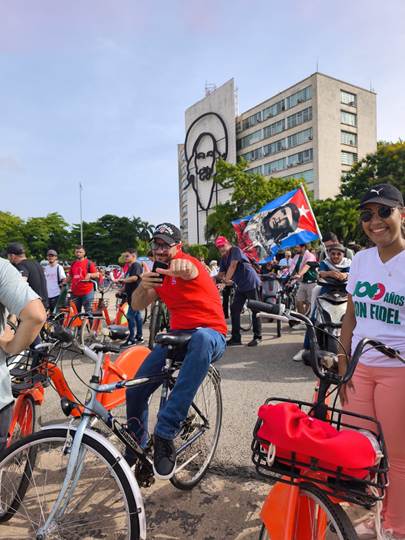
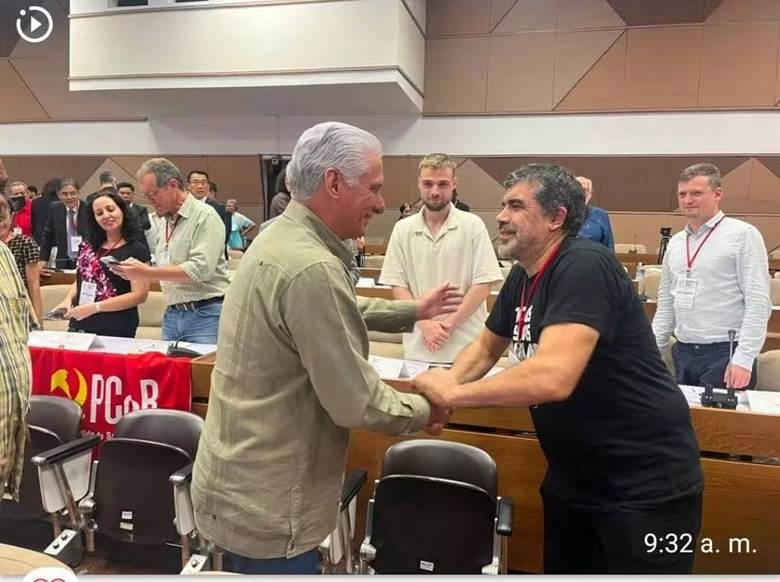
I came to Cuba as part of a delegation of solidarity from the International Peoples Assembly, a platform of hundreds of organizations from around the world that are trying to reestablish movement-to-movement internationalism. Our delegation was led by João Pedro Stedile (national direction of the Brazilian Landless Workers Movement), and included Fred M’membe (President of the Socialist Party of Zambia and the opposition’s candidate for president this year), Brian Becker (one of the leaders of the Party for Socialism and Liberation in the United States), Manolo De Los Santos (director of The People’s Forum), Giuliano Granato (one of the leaders of Potere al Popolo from Italy) as well as Manuel Bertoldi and Laura Capote (coordinators of the ALBA Movements). We visited many places, including the Latin American School of Medicine (ELAM), the Institute of Neurology, the Martin Luther King Center and Casa De Las Americas. We met with the Central Committee of the Communist Party of Cuba and the President of Cuba, as well as countless ordinary Cubans. We went to the main cemetery in Havana to pay homage to the 32 Cubans who lost their lives defending Venezuelan sovereignty, and we walked around the city of Havana to meet people who were going about their everyday lives.

During one of the conversations, a friend asked how I found Cuba, a place I have visited countless times over the past 30 years. I said that I found the situation difficult but that the people seemed irrepressible. My friend was clear: the prevailing sensibility in the country was that the Cubans would fight to the very end to defend their right to a future and their refusal to return to 1958, the year before the Revolution.

During the early years of the Revolution, Fidel Castro made it clear that the urgency was to solve the people’s immediate needs and problems. This meant that the Cuban Revolution placed its emphasis on ending hunger and poverty, illiteracy and ill health, as well as providing housing and cultural spaces. To see the deterioration of life because of the harsh, nearly 70-year Embargo and the new Oil Blockade is heartbreaking. The priority remains to ensure that every Cuban can live a life of dignity. This was the message as well from the President of Cuba, Miguel Diaz Canel, a man of great humility: we will resist, he said, but we will not permit the Revolution to squander its gains and its emphasis on the well-being of our people.

Sitting on a rocking chair beside my friend Abel Prieto, a former Minister of Culture, in Casa De Las Americas, was a tonic. As usual, Abel, my fellow Marxist-Lennonist (!), made me laugh aloud and at the same time feel sorrow. His comments ranged from an assessment of Trump (with “madness” being the word most often used) to his sense of the vitality of Cuban reality (the remarkable crowds that stood in pouring rain to pay homage to the remains of the Cubans killed by the US forces in Venezuela on January 3). I felt comforted by his balance between humor and clarity, Abel’s literary sensibility in control of the fast-moving situation.

I accepted Abel’s view that perhaps the United States in its current form is a gigantic mistake – the arrogance of Trump a reflection of something inherent in the extreme idealism that the United States and its administrations know better than anyone else. They believe they know better what should be done to the Palestinians, the Venezuelans, the Iranians, and the Cubans. In the name of “democracy,” the democratic rights and existential rights of the people in these darker nations are utterly absorbed by the US President – the holder of preponderant power. It is an ugly vision but a real one, a reality that rips sensitive people around the world away from their own desire to shape a reality that is not so hideous. A third of the people killed in Iran by the United States and Israel are children, and the children of Palestine, whose names we honor, will never become adults.

**

On my last day, I saw a group of Cuban schoolchildren playing in a park, dressed in their school uniforms, their revolutionary scarves around their necks. They were chirping with laughter and chatter. I watched them from across the road playing a game, supervised by two smiling teachers, with some cones on the ground – a game that required them to weave between them. These children must have been about five or six, boys and girls who played in a cocoon of great happiness. I sent them a virtual hug. Be safe children. Always. Hug Cuba for me every day.

Vijay Prashad is an Indian historian and journalist. He is the author of forty books, including Washington Bullets, Red Star Over the Third World, The Darker Nations: A People’s History of the Third World, The Poorer Nations: A Possible History of the Global South, and How the International Monetary Fund Suffocates Africa, written with Grieve Chelwa. He is the executive director of Tricontinental: Institute for Social Research, the chief correspondent for Globetrotter, and the chief editor of LeftWord Books (New Delhi). He also appeared in the films Shadow World (2016) and Two Meetings (2017).

This article was produced by Globetrotter.