Categories
Uncategorized

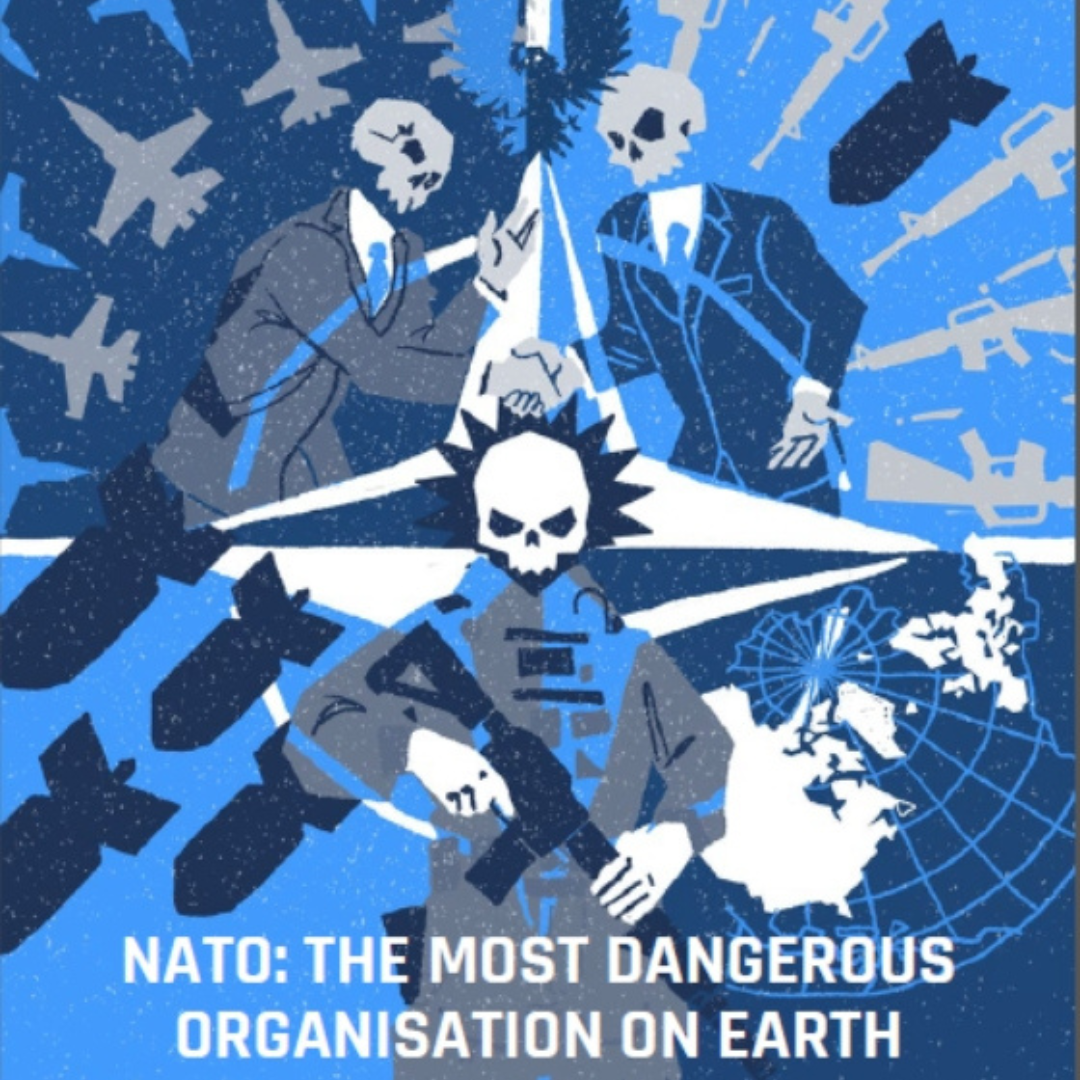
It’s time to consign NATO to the dustbin of history

By Biljana Vankovska

As NATO’s next summit looms – against the backdrop of an escalating proxy war in Ukraine and a genocidal horror in Gaza – the sane and moral world must roar in defiance, shattering ideological shackles. NATO is a zombie alliance, lurching forward despite its irrelevance, its fangs dripping with the blood of nations it claims to protect. In Ukraine, NATO’s members pour fuel on the inferno, championing escalation over peace. The United States, its puppet-master, plays a vile charade – preaching peace while strong-arming allies to bankroll its war machine. Trump’s $175 billion Golden Dome, a space-based missile defence boondoggle, is a reckless gambit that threatens global annihilation.

Without US muscle, NATO is a toothless fraud. Its true mission – past and present – is not defence but terror-mongering, fabricating enemies to feed the ravenous military-industrial complex. This hydra now entwines media, academia, and Hollywood, peddling war as entertainment. NATO is a global arms bazaar, hawking obsolete weapons and testing new ones on the corpses of the vulnerable. Its mantras – ‘peace through strength’, ‘path to peace with more weapons’ – is Orwellian poison, weaponising language to silence dissent. Those who dare question this madness are smeared as traitors to peace.

The Hague summit will churn out its tired script: skyrocketing military budgets – now potentially 5% of GDP – siphoning resources from health care, education, and the poor. Russia and China will be vilified as existential threats to justify this plunder. NATO flouts the UN Charter and its own founding charter, leaving a trail of ravaged nations and dead civilians. Its cheerleaders – think tanks, the media, and warmonger officials – demand a ‘stronger, fairer and more lethal NATO’, lusting for hypersonic weapons, preemptive strikes, and space militarisation. This is not defence; it’s domination on steroids.

The 1999 bombing of the Federal Republic of Yugoslavia was a turning point in NATO’s history. Launched without UN Security Council approval, it was a brazenly illegal assault, justified by a sham ‘humanitarian’ pretext. No legal basis existed; NATO’s actions mocked Articles 51 and 2(4) of the UN Charter, setting a blueprint for lawless militarism dressed in moral drag. Article 2(4) enshrines the principle of state sovereignty and prohibits unilateral use of force. Article 51, which governs the right to self-defence, provides the only explicit exception to this rule, allowing military force solely in response to an armed attack. Since NATO’s intervention was neither authorised by the UN Security Council nor conducted in self-defence, it constituted a breach of both provisions of the UN Charter.

Its 50th anniversary was celebrated with bombs on a sovereign state that did not threaten NATO whatsoever. It was the promotion of the ‘out-of-area’ doctrine – something that would prove very useful in the forthcoming interventions in Afghanistan, Libya, and Syria. The 1999 bombing campaign wasn’t about human rights protection – it was imperial border-carving, birthing client states like Kosovo and outposts like Camp Bondsteel, the United States’ Balkan fortress. The Kosovo conflict was complex, its suffering real, but NATO’s illegal intervention unleashed chaos, unaccountable for war crimes like depleted uranium, civilian infrastructure strikes and a significant number of ‘collateral deaths’. It gave the hegemon a blank check to redraw maps and shatter states. It de facto opened the Pandora’s box for any other great power.

In May 2000, during a lecture at the George C. Marshall Center marking the first anniversary of NATO’s intervention, I issued a Cassandra-like warning: that Macedonia – my country – would soon be drawn into military conflict as a result of the spillover effect. Nine months later, that prediction became reality. NATO, alongside the EU, imposed a logic of ethnic partition, echoing the blueprint used in Bosnia. To this day, the Balkans suffocate under the legacy of NATO’s so-called ‘military humanism’ (to borrow Chomsky’s phrase). The EU’s state-building medicines did the rest. The entire region still resembles a powder keg. Ironically, in 2018, Macedonia – renamed North Macedonia – surrendered its constitutional identity in exchange for NATO membership, seduced by hollow promises of peace, prosperity, and security. Instead, the country finds itself entangled in the Ukraine quagmire, expected to allocate up to 5% of its GDP to armaments, while more than a third of its population languishes in poverty.

NATO’s economic and social toll is catastrophic. Its demand for ever-higher military budgets – 2% of GDP, now 3.5%, or 5% – is a death sentence for social welfare. Hospitals crumble, schools decay, and citizens are crushed under austerity while NATO’s warlords feast on our taxes. Anti-NATO circles rightly decry this economic vampirism, but their calls for budget restraint or austerity tweaks are band-aids on a terminal disease. These palliative measures leave the beast intact, free to drain nations dry. The real cure is radical: disband NATO entirely and embrace a multilateralism based on the UN Charter principle: peace by peaceful means. Anything less is complicity in its crimes.

Peace movements will protest the summit in The Hague and elsewhere, but NATO’s elite, barricaded behind security cordons, will sneer, as will their media lapdogs. NATO’s complicity in Gaza’s genocide and Ukraine’s catastrophe will be buried. The ruling class, deaf to public outcry, thrives on our practicality and civility. Peace activism must be a relentless, daily rebellion, not summit-pageantry. The warmongers rule our nations, funded by our labour and taxes, making this fight local, too. In my country, Macedonia, the Levica (Left) party demands the country’s withdrawal from NATO. My 2024 presidential programme proposed a simple, defiant act: a letter to the US State Department to exit the alliance and embrace neutral status instead.

In a fractured, multipolar world, where Trump’s erratic reign has shattered order, NATO and the EU are fusing into a militarised monolith. The EU’s ReArm initiative erases their boundaries. This isn’t about ideology; it’s about survival. Like the child in Andersen’s tale, we must scream the truth: NATO is a naked destroyer, perpetuating violence (physical, structural, and cultural) while gutting the UN system and imperilling global peace.

Disband it. Leave it. Choose military neutrality and work for a shared future for humanity. Nothing less will do.

No to NATO. Yes to Peace.

The above article was produced by Globetrotter. Biljana Vankovska is a professor of political science and international relations at Ss. Cyril and Methodius University in Skopje, a member of the Transnational Foundation of Peace and Future Research (TFF) in Lund, Sweden, and the most influential public intellectual in Macedonia. She is a member of the No Cold War collective.

Categories
Uncategorized

Europe’s left must unite to oppose NATO’s rearmament and austerity

By John Ross

As Europe approaches NATO’s 24–26 June summit in The Hague, its 750 million people face a decisive strategic choice that will affect their lives for years to come – and one with far wider global impact.

The policies implemented in Europe in recent years have been disastrous socially, economically, politically, and militarily. Europe is experiencing worsening social conditions, its largest war since 1945 in Ukraine, and the biggest rise of far-right authoritarian, racist, and xenophobic forces since the Nazis in the 1930s.

The proposals to the NATO summit would worsen that situation. The key question is therefore whether Europe will continue down this destructive, disastrous path or adopt policies that offer a way out.

NATO Secretary-General Mark Rutte has proposed to the 32 NATO members that ‘the NATO summit… aim for 3.5% hard military spending by 2032’ – a 75% increase from the previous 2.0% of GDP target.

Trump calls for even higher military expenditure of 5% of GDP. Rutte opened the door to this by supporting a commitment to ‘1.5% related spending, such as infrastructure, cybersecurity, and things like that. Also achievable by 2032’. The 3.5% plus 1.5% adds up to Trump’s 5%.

The social and political consequences of such a course are already clear. Europe’s economies are nearly stagnant, with the EU’s annual per capita GDP growth averaging less than 1% from 2007 to 2024. The IMF, somewhat optimistically, projects an increase to only 1.3% by 2030. With rising inequality and reductions in social spending due to austerity policies, hundreds of millions of people in Europe have already experienced stagnant or declining living standards. Diverting more resources into military spending, already being accompanied by social spending cuts to finance it, will worsen that situation further.

The political consequences are also clear. Far right and neo-fascist forces, exploiting the worsening conditions, which are actually caused by austerity measures and increased military spending, by demagogically blaming immigrants and ethnic and religious minorities, will gain further strength.

The disastrous consequences for traditional left-wing and progressive parties supporting or enacting these rearmament and austerity policies, even before their support for the new NATO rearmament policies, are already known in major European countries. The SPD in Germany in 2025 saw its vote drop to 16%, the lowest since 1887. In the last elections at which they stood independently, the French Socialist Party gained only 6%. In Britain, the Labour Party, which already received one of its lowest votes since the 1930s at the last election, is now in the polls behind the far-right Reform Party.

In contrast, left-wing parties that have opposed austerity and NATO policies – La France Insoumise in France, Die Linke in Germany, the Belgian Workers Party – have maintained or significantly increased their support.

This disastrous collapse suffered by traditional left-wing parties that have supported war and austerity is extremely dangerous in the context of the rise of far-right parties across Europe.

The reason for the collapsing support for such parties is obvious. Such policies attack the population’s living standards. If parties claiming to be on the left continue to support austerity and rearmament, this trend of decline will just continue.

The only way out of this situation for both Europe’s population and the left is a complete policy reversal to one that prioritises social progress and economic development.

Following the end of the Cold War, Europe should have focused on fostering economic cooperation and minimising military tensions and expenditures. This would have created a balanced economic area, equivalent to the US, with a strong potential for growth by combining Western Europe’s manufacturing and services with Russia’s energy and raw materials. What was possible was shown in Asia by ASEAN, which, in a continent that had suffered the worst conflicts of the Cold War, the Korean and Vietnam wars, became the world’s most rapidly growing economic region through a concentration on economic development and the absence of military blocs.

But, because an economically cooperating Europe could have been a successful competitor to the United States, US administrations pursued a path to prevent it – primarily through NATO’s eastward expansion, which was carried out in direct violation of US promises to then-Soviet Premier Gorbachev that NATO would not advance ‘an inch’ eastward after Germany’s reunification. Instead, in 1999, 2004, 2009, 2017, and 2020, new countries were added to NATO, and the door was deliberately left open to admitting Ukraine, known to be a red line for Russia due to Ukraine’s proximity to Russia and its position as a historical route for invasion.

Numerous US experts on Eastern Europe opposed this, led by George Kennan, the original architect of US Cold War strategy, who warned NATO expansion would be ‘the most fateful error of American policy in the entire post-Cold War era’. But their warnings were ignored, with results culminating in the Ukraine war.

Now NATO demands rearmament and cuts in social protection to finance this war.

NATO forces simultaneously expanded outside Europe to participate in wars in the Global South, Afghanistan and Libya, set up numerous organisations and initiatives to prepare intervention in the Global South – such as the Istanbul Cooperation Initiative, the Strategic Direction-South HUB, the Liaison Office in Addis Ababa – and has begun to expand into the Pacific – with Japan, Australia, New Zealand, and South Korea attending every NATO summit since 2022. Such NATO expansion would involve Europe in even more conflicts and more calls for military expenditure.

What is required is the complete opposite – priority to social progress and investment for economic growth. Both require more spending and are therefore directly contrary to a military build-up.

Europe’s need for social spending is obvious. But Europe’s investment, the key to economic growth, has also collapsed. In the EU, investment, once depreciation (the wearing out of existing means of production) is taken into account, has halved from 7.4% of GDP in 2007 to only 3.5% on the latest data. International comparisons show this is enough only to generate 1% annual economic growth.

Additionally, the US is now pressing for further policies harmful to Europe and its people. The US has already enormously damaged Europe by its conscious policy of cutting off Western Europe’s source of cheap energy from Russia, achieved via the Ukraine war and the blowing up of the Nord Stream pipeline, which anyone who looks seriously at the matter knows was carried out by the US.

The Wall Street Journal now reports the US is seeking a ‘commitment from EU leaders to place new tariffs on Chinese industries’ – which would inevitably lead to equivalent retaliation by China, damaging Europe’s economy.

Simultaneously, the US proposes tariffs against Europe’s exports, followed by the imposition of an international trading system, replacing the extremely imperfect WTO with an even worse system in which the US unilaterally decides tariffs and rules!

Europe’s people have already suffered huge blows to their living standards because of US policy. They cannot afford more. On the contrary, Europe should, simultaneously with rejecting increases in military spending and social cuts to finance it, be seeking to regain access to cheap energy from Russia and expanding trade with China as part of a policy of economic recovery.

Faced with the disastrous proposals to the NATO summit, the left across Europe has begun to coordinate activity against increases in military spending through establishing Stop ReArm Europe. It is vital that all forces across the continent opposed to NATO’s policy further strengthen activity and cooperation.

The above article was produced by Globetrotter and No Cold War. John Ross is a senior fellow at Chongyang Institute for Financial Studies, Renmin University of China. He is also a member of the international No Cold War campaign organising committee. His writing on the Chinese and US economies and geopolitics has been published widely online and he is the author of two books published in China, Don’t Misunderstand China’s Economy and The Great Chess Game. His most recent book is China’s Great Road: Lessons for Marxist Theory and Socialist Practices. He was previously director of economic policy for the mayor of London.

Categories
Uncategorized

Tariff War and Protracted War

It has been nearly a month since the Trump administration announced the imposition of so-called “reciprocal tariffs” on U.S. trading partners – thereby provoking a global trade war. But the development of the situation has greatly exceeded the expectations of the U.S.. Not only did the Chinese government take the lead in showing a clear attitude of being willing to respond to the U.S. “to the end” but the anti-bullying positions of the international community have become louder.

Due to a focus on this situation in which the U.S. is fighting indiscriminately, and China is responding to each move, the trend of China’s domestic public opinion is also changing. The views once put forward in some places of a “China must lose theory” and the “surrender at the speed of light theory” are disappearing. More and more people realize that China “knows what it is doing and it has cards to play in its hands”.

But at this time, however, new misconceptions have also appeared.

One is “quit while you are in the lead”, thinking that China’s “tough stance” will eventually be difficult to maintain. Now the Trump administration seems to be softening it is necessary to stop at the right moment, claim that a small loss is in fact a victory, and make concessions and compromises as soon as possible to reach an agreement to avoid entering a stage of a difficult strategic stalemate.

The other view is that “victory is in sight”. which, seeing the US’s chaotic actions and softened rhetoric, then thinks that “the U.S. is afraid”. This view optimistically predicts that the outcome of the trade war has already been decided and China will soon be able to achieve a complete victory.

So, why are these arguments wrong, and how can we rationally view this present round of Sino-US struggle?

The “Biography of Mao Zedong”, compiled by the Literature Research Office of the Central Committee of the Communist Party of China, wrote: “The work ‘On Protracted War’ is full of dialectics and materialism and it has universal value in the methodology for analysing things.”

In May 1938, after defeat in the battle of Shanghai, the loss of Xuzhou, with Wuhan in a critical condition, Chinese society was in chaos and with loud discussion. At this critical moment, Comrade Mao Zedong calmly analysed the situation at home and abroad, and spent seven days and seven nights writing a speech “On Protracted War”. In this article, Comrade Mao Zedong did not use many obscure and difficult concepts to reason with. The whole article uses dialectical materialism and historical materialism to analyse the War of Resistance against Japan, and forcefully refutes various false arguments, clearing away confusions for the Chinese people to win the War of Resistance against Japan.

To understand the correct path it is necessary to first study history. Although today’s Sino-US struggle cannot be equated with the War of Resistance Against Japan in its character, the results of both are related to the direction of the country and the dignity of the nation. Amidst the chaotic clouds  it is a good idea to reread “On Protracted War” in order to understand the dialectical thought that “danger and opportunity coexist” as well as China’s strategic vision of why it will “secure a final victory”.

The Trump administration, which has existed for less than a hundred days, has unleashed a storm of tariffs. The aim was to secure a rapid victory, using huge pressure to force its opponents into defeat, and to reach rapid unequal deals in order to harvest the maximum benefits.

Facing this butchers knife, many countries have fantasized about ”feeding themselves to the wolves” in order to secure a moment of peace. But for China, it is simply unworkable to “ask for mercy”.

As the world’s second-largest economy China’s size cannot be concealed. even if  China lowers its posture, cold war thinking would still see it as an enemy to be eliminated. The Trump administration wields the stick of tariffs to try to extort and blackmail. Its overbearing and cruel methods are unprecedented. This is an extreme provocation against China’s national sovereignty and dignity. We have no room for concessions, let alone any reason to give in.

This round of U.S. tariffs covers more than 180 countries and regions around the world, which constitutes serious damage to the world trading system. As a responsible power, China resolutely opposes the US bullying tariff behaviour, not only in order to defend its own sovereignty, security and development interests, but also to defend multilateralism and justice in the world trading system.

Stiglitz, Nobel laureate in economics and a famous American economist, once satirically wrote: “U.S. members of Congress rely on the money of the 1% for re-election, serve the 1%, and even rely on the 1% to reward them when they leave office.”

The various contradictions which have accumulated in American society today are ultimately caused by the deterioration of the capitalist system. As spokesperson for the interests of capital, the U.S. government is absolutely unable to “self-revolutionize” and solve the root causes of these conflicts. It has to utilise suppression, extortion, exploitation and other means to transfer its conflicts to the outside world. This means that whether it is a trade war, a tariff war, or some other war, what the U.S. resorts to is risky behaviour, a gambler mentality, with an attempt to divert attention from its own irreconcilable contradictions. It is destined to act against the trend of human history.

In contrast, today’s China, as an “enabling power”, has always adhered to the development concept of a community of human destiny. It firmly stands on the side of maintaining globalization and a normal trade order, advocates mutual benefits and a win-win situation, and opposes unilateralism.

At the same time, China’s development has never been the result of gifts from others. It is the result of hundreds of millions of people’s self-reliance and hard work. For more than 70 years since the establishment of New China, China has always broken through blockades and overcome attempts to suppress it and has accumulated a wealth of experience in these struggles. This determines that China’s “carrying through to the end” is not purely words but is in line with historical laws. It is just, progressive, and a just cause enjoys abundant support. “The times and the situation are on our side, and victory ultimately belongs to China.”

The people are the true creators of history. In “On Protracted War”, Comrade Mao Zedong summed it up as “the soldiers and the people are the foundation of victory.” In the contemporary context, this thought can be extended as “the whole people are united and concentrating on doing their work well”. That is, in the protracted struggle between China and the United States, the most critical issue is to achieve China’s own development, improvement, progress and growth.

From the perspective of national strategy, this can be seen in the proposing of a new development pattern with the large domestic economic cycle as the main force, and the mutual promotion of the domestic and international twin cycles; to propose the development of new quality productive forces, shaping the development of new kinetic energy and advantages for growth; to deeply promote the construction of a unified large market across the country. Regarding the long-term nature of the Sino-US competition the Party Central Committee has already predicted that it will take the initiative to lay out a plan for the competition of major powers. This is the root of our confidence in dealing with attempts to contain and suppress China.

From the perspective of industrial development, both the Trump and Biden administrations are addicted to imposing technological sanctions, but they in reality imprison themselves, and even give rise to what might be called China’s “crisis dividend”. In recent years, China has concentrated its most advanced resources to break through the technological “chokepoints” and accelerate the domestic progress of key link industries such as artificial intelligence, big data, integrated circuits, and new energy. These have grown rapidly, showing strong capabilities in the strategic mobilization of resources and concentrated breakthrough capabilities.

At the social level, having dealt with various shifts, Chinese people have become more and more aware that the words the “imperialists desire to destroy China never dies” is not a hollow phrase. Only by daring to fight, and being skilful at fighting, can we turn danger into opportunity and secure  safety. After the Trump administration launched this round of trade war, many patriotic stories have unfolded: such as e-commerce platforms helping companies reliant on foreign trade to shift to domestic sales, consumers strongly supporting domestic production, shareholders following the “national team” to protect the country, and students declaring “scientific research serves the country”. Mainstream public opinion is highly united and has shown a strong awareness of the historical situation. This national ability of self-awakening, self-regulation, self-pressure, and self-optimization is the core support for the ultimate victory in the protracted struggle. .

Comrade Mao Zedong once emphasized: “The Chinese people are ambitious and capable, and they will catch up with and surpass the world’s advanced level in the far from distant future.” Today’s China is step by step turning that into a reality.

“Each generation has its own war of Resistance” [against Japan] and “each generation has its own Battle of Triangle Hill” [a major victory by China over the U.S. during the Korean war], these are popular comments on China’s internet after the United States provoked the new round of trade wars. History never repeats itself, but it always rhymes. Today, revisiting “On Protracted War” is not only because it provides us with a clear framework for strategic understanding, but also because the methodological wisdom, dialectical materialism, and mass line thinking it contains offers great enlightenment for international struggles in the new era.

By always adhering to sober strategic judgment, scientific methods of thinking, and a firm will to act, we will definitely be able to successfully complete this “long march in the new era”.

The above article, analysing China’s response to the tariff war launched by the U.S., was originally published in Beijing Daily under the title “Today, it is necessary to reread ‘On Protracted War’”. It was also published online here in Chinese.
Categories
Uncategorized

“If international trade reverts to the ‘law of jungle,’” all will be victims, China warns

By Abdul Rahman

Speaking in an informal meeting of the UN Security Council on Wednesday, April 23 China’s permanent representative Fu Cong questioned the unilateralism pursued by the US in international trade claiming it “severely infringes upon the legitimate rights and interests of all countries” and violates the rule based multilateral trading system.

Cong claimed a multilateral approach remains the only option for the advancement of all countries and affirmed “no country has the right to put itself above international law” and dictate terms to others. He offered Chinese cooperation in dealing with the situation to the countries which are willing to stand for free and fair international trade.

China’s reaction was a response to the “tariff war” unleashed by US President Donald Trump ever since he began his second term in January this year. Under the so-called reciprocal tariff regime, the US announced high tariffs against imports from most of the countries in the world.

The implementation of the “reciprocal tariffs” has been postponed for 90 days for all countries except China, whose exports to the US currently face a 145% tariff. Meanwhile, the Trump administration has offered bilateral negotiations to reach agreements with the countries that want to avoid the announced reciprocal tariffs.

In response to the steep tariff against its goods, China announced a 125% tariff on imports from the US. It also vowed to fight Trump’s strong arming tactics and has so far refused to sign a bilateral agreement. It has also called the arbitrary tariff hikes a violation of international trade laws and demanded the reversal of the policy.

Amid the flurry, China has proposed that countries make a coordinated response to Trump’s tariff war, citing that individual agreements may harm global trade.

Chinese Finance Minister Lan Fo’an and the Governor of China’s Central Bank (the People’s Bank of China) Pan Gongsheng reiterated their country’s position during the G20 finance minister’s meeting in Washington DC which concluded on Thursday, April 24.

Claiming that trade tensions, created by Trump’s arbitrary policies, “are disrupting global industrial and supply chains, undermining the momentum of global economic growth,” Pan claimed trade and tariff wars have no winners. He pushed for greater economic and financial coordination. Lan called for strengthening multilateral cooperation to face the difficult times ahead, Global Times reported on Friday.

No appeasing the bully

China said earlier this week that to “safeguard legitimate rights and interests” and to “defend fairness and justice” in international trade all the affected countries should coordinate their moves warning that dealing with it individually may lead to compromises harming the global trade as a whole.

The coordination of their moves is the way to deal with the “hegemonic politics” and “unilateral bullying” adopted by the US which attempts to deprive opportunities for development to a large number of countries across the globe, the spokesperson of China’s Ministry of Commerce said during a press conference on Monday.

Since Trump announced the reciprocal tariffs and their postponement, there has been a rush of affected countries seeking bilateral deals with the US as a way to avoid the high tariffs. Some of them are close neighbors of China such as Japan and South Korea. China cautioned these countries against the temptations to appease Trump’s hegemonic moves in their haste. It particularly warned against “selfish” compromises with the US which can harm third countries.

Various media reports have indicated that the Trump administration is pressuring countries seeking bilateral agreements with the US to reduce their trade ties with China and impose barriers.

China maintained that it respects every country’s right to safeguard its interests and negotiate deals with the US. However, it warned that such deals should not come at its own cost. It warned that if China’s interests are harmed, it can take reciprocal measures as “it is determined and capable of safeguarding its own rights and interests.”

“Sacrificing others’ interests to obtain so-called exemptions for temporary selfish gains is akin to negotiating with a tiger; it ultimately leads to failure for both the parties and harms everyone involved,” the Ministry of Commerce spokesperson said.

“Appeasement cannot bring peace, and compromise will not earn respect,” China warned, claiming that, “If international trade reverts to the ‘law of jungle’, all countries will become victims.”

China said it expects all countries to stand “on the side of fairness and justice, on the side of historical correctness” as no one is immune to “unilateralism and protectionism.”

The above article was previously published by Peoples Dispatch.

Categories
Uncategorized

The turbulence in the global economy

By Vijay Prashad

On April 22, 2025, the International Monetary Fund (IMF) released its annual World Economic Outlook report, which has a quiet but decisive subtitle: A Critical Juncture and Policy Shifts. The report, once more a hefty piece of work by the IMF economists and their associates, rushes to make sense of the tariffs first threatened by US President Donald Trump and then delayed, and then, as if the flurry was not sufficient, retained and increased against China. The IMF attempts to make the case that through 2024, “global growth was stable” and that the current downgrade to global growth is largely a factor of the Trump tariff “uncertainty” and “unpredictability”.

The IMF releases this report during the annual week of meetings of the Fund and the World Bank. At the start of the meetings, IMF Director Kristalina Georgieva reflected on the situation in the global economy and claimed that the turbulence is largely due to “an erosion of trust”. No longer, she said, do countries trust each other as they once did, nor do they trust the international system. Apart from the reversal of the tariffs, the IMF says that what needs to be built once more is trust in international economic affairs.

Whispers in the corners of the IMF and World Bank meetings are all about the irrationality of the Trump administration, and – in particular – the unpredictability of Trump’s own statements. With the head of the North Atlantic Treaty Organisation (NATO) beside him, Trump told a press conference in the White House that Canada is not a real country but would be an excellent state within the United States. That sort of comment creates fodder for the hushed giggles at the edges of this meeting, when otherwise serious men and women in business suits maintain a rictus look of concern for high affairs of state.

Errors in judgment

One of the significant errors in the assessment by the IMF is that everything in the Western economies had begun to look stable last year. While it is true that the threat of the tariffs and then the anti-China tariffs themselves created “a major negative shock to growth”, it is not true that growth rates had been expected to reach new heights this year.

Growth in the US has been significantly below its historic trend since the 2007-08 subprime mortgage crisis-induced financial crisis – indeed, US growth since then has been cumulatively lower than in the Great Depression. In the 17 years after the Great Crash of 1929, US annual GDP growth averaged 3.7%, whereas in the 17 years since the International Financial Crisis, US annual growth averaged only 2.0%.

In October 2024, the IMF projected that the United States would grow at 2.2%, and since reduced its forecast to 1.8%. Meanwhile, in October last year, it suggested a rate of 4.5% for China and 6.5% for India, far higher than for either the US projected rate or the advanced economy projections (1.8%). The Trump tariffs certainly compounded the problems for the US, but they are not the cause of the problem. Sluggish growth has been the situation for almost two decades.

On that sluggishness, the IMF’s new World Economic Outlook is remarkably bland. It suggests that the “core macroeconomic policy challenge” of the United States is its federal government debt. This debt, which is 36.2 trillion, is 124% of GDP. Ten global north countries are in the twenty countries with the highest debt-to-GDP ratios: Japan (266%), Greece (193%), Italy (151%), United States (124%), Portugal (122%), Spain (117%), France (112%), Belgium (111%), Canada (109%), and the United Kingdom (105%). Cutting the deficit might make good macroeconomic sense, but it does not by itself propose a way back to growth for the United States. Lower social welfare spending will further deplete private consumption. And Trump’s dream of revitalizing US manufacturing is not going to work merely through a reduced federal government deficit without a massive, massive release of resources for industrialization. Without an attack on living standards, this could only come from measures such as a reduction in excessive US military expenditure or reform of the country’s grotesquely inefficient private health system. These are policies Trump will not adopt.

In fact, the IMF gives notoriously poor advice to the Chinese government. It suggests that China should emulate the United States rather than the other way around. China, the IMF says, should “boost chronically low private consumption” and “dial back industrial policies and pervasive state involvement in industry”. In other words, abandon its long-term growth profile and become like the slow-growing United States!

In November 2024, the IMF released an interesting paper by its economists (Dirk Muir, Natalija Novta, and Anne Oeking) called “China’s Path to Sustainable and Balanced Growth”. The paper and the World Economic Outlook together make the case that China’s strong economic performance comes from its COVID stimulus, its high exports, a high domestic savings rate to finance public infrastructure, its banking system that directs liquidity to small and medium-sized enterprises to generate productive activity rather than property speculation, and an emphasis on high-quality productive forces. This is a fairly good summary of the structure of Chinese growth over the last period. But it is totally counter to the suggestions that the IMF then gives to China: which is to liquidate everything that allowed it to stave off the long term sluggishness of the advanced industrial countries (including to pressure the renminbi to appreciate, as the US would like so that its trade imbalance can be rectified by a foreign exchange shift rather than by greater productivity in the US itself).

The IMF is right. There is great uncertainty ahead. But there is also certainty in its own reports and in its charts. High domestic savings and better sovereignty of resources (including the financial system), alongside canalization of these finances to the productive sector (for infrastructure and industrialization), produce more stability in the long run than an excessive reliance on private financial markets and the whims of the billionaire class. But the IMF does not close its new report with that news. It prefers to look out of the window and see the storms in the Western skies rather than the calm in the East.

Vijay Prashad is an Indian historian, editor, and journalist. He is a writing fellow and chief correspondent at Globetrotter. He is an editor of LeftWord Books and the director of Tricontinental: Institute for Social Research. He has written more than 20 books, including The Darker Nations and The Poorer Nations. His latest books are On Cuba: Reflections on 70 Years of Revolution and Struggle (with Noam Chomsky), Struggle Makes Us Human: Learning from Movements for Socialism, and (also with Noam Chomsky) The Withdrawal: Iraq, Libya, Afghanistan, and the Fragility of US Power.

This article was produced by Globetrotter.

Categories
Uncategorized

Will Trump’s trade war spark a real war?

By Wang Wen

Will there be a war between China and the United States? This question surged into popular discourse in early April, largely because China was the first country to impose strong retaliatory measures in response to Trump’s so-called “reciprocal tariff” policy.

Some now worry that the global atmosphere increasingly resembles the era of tariff wars that preceded World War II—prompting fears that economic conflict could escalate into military confrontation.

Which country might next go to war with the United States? Yemen? Iran? Perhaps a nation in Africa or Latin America? In my view, it most certainly won’t be China.

This is not because China is weak or unwilling. On the contrary, defending its national interests and dignity remains central to Beijing’s strategy in dealing with Trump’s economic provocations. On no issue will China simply yield to Donald Trump’s increasingly unrealistic demands.

Since Trump’s first term began eight years ago, China has grown acutely aware of what it sees as Washington’s hegemonic imperialism. Beijing has always preferred cooperation with the U.S., never desiring to cast it as an adversary. But if the U.S. is intent on launching a trade war, a tariff war, a tech war—or any other kind of confrontation—China is prepared to fight back.

China does not rule out cooperation with the U.S. when it is based on mutual respect and a shared interest in “win-win” outcomes. But it understands that meaningful cooperation cannot be passively pursued; it must be earned through sustained struggle.

In this latest round of tariff disputes, China’s retaliatory actions have been notably restrained, focused solely on trade. It does not want friction with the U.S. to spiral out of control. One telling sign of this is the silence of China’s top leadership—apart from statements issued by the Ministry of Foreign Affairs and the Ministry of Commerce, no senior official has publicly commented on Trump’s tariff moves.

This reflects a posture of strategic calm. China’s leadership has maintained a tone of resilience and rationality, demonstrating the emotional steadiness and long-term foresight of a global power.

Few now remember that, just three days before his inauguration on January 20, Trump spoke by phone with Chinese President Xi Jinping. Xi emphasized that as two major powers with vastly different national conditions, it is inevitable that China and the U.S. will have disagreements. What matters, Xi argued, is that each side respects the other’s core interests and major concerns and finds constructive ways to resolve disputes. He also reiterated that the nature of China-U.S. economic ties lies in mutual benefit and “win-win” cooperation—warning that confrontation should not be the default path.

Indeed, China’s reluctance to enter into direct confrontation with the U.S. stems not from fear, but from deep confidence in its own growing power. It knows it would not be the loser in a conflict.

In the 1950s, China lacked an established navy and air force, and yet it fought the U.S. to a stalemate in the Korean War, forcing an American retreat to the 38th parallel. Today, the contrast is stark. China has three aircraft carriers deployed in the western Pacific and is poised to build more. It fields Dongfeng-31AG intercontinental ballistic missiles with a range of 12,000 kilometers, sixth-generation fighter jets, and accounts for over 70 percent of the world’s drone production. The idea of a U.S. military victory over China is increasingly unrealistic.

And the U.S. knows it. Think tanks like the RAND Corporation and the Center for Strategic and International Studies have published simulations of possible war scenarios between China and the U.S. over Taiwan, the South China Sea, or the Korean Peninsula. The conclusions are sobering: not only could the U.S. fail to win, but it could face a catastrophic defeat.

Still, why wouldn’t China, with all this power, strike first? The answer is plain: it won’t. Over the past four decades, China has never initiated conflict with the U.S. On issues ranging from Xinjiang, Tibet, and Hong Kong to the South China Sea, human rights, trade, and technology, it has consistently been Washington that has taken the first aggressive step.

Even now, in the face of what has become the world’s largest tariff war, China has shown that it can defend its interests without resorting to military means.

China’s export competitiveness remains formidable, especially in sectors such as lithium batteries and toys. Seven years ago, Trump’s initial tariffs raised the cost of Chinese goods by 20 percent. Yet, U.S. imports from China continued to rise.

According to U.S. Department of Commerce data, from January 2024 to January 2025, American exports to China dropped by $2.18 billion—an 18 percent decrease from $12.1 billion to $9.9 billion—while imports from China increased by $5.85 billion, or 16.3 percent, from $35.8 billion to $41.6 billion.

Even if tariffs were raised to 200 percent, the U.S. would still rely heavily on Chinese imports. Conversely, U.S. products such as soybeans and crude oil have limited appeal in the Chinese market. China’s retaliatory tariffs are forcing American exporters to seek new markets, with substantial losses likely for U.S. agriculture and energy sectors.

Meanwhile, Chinese manufacturers are increasingly expanding their international operations. Trump’s tariffs have had the unintended effect of pushing China’s companies toward greater globalization. Until recently, many Chinese firms had minimal international presence. Now, they’re building a global footprint. In this light, Beijing sees Trump’s trade war not as a crisis but as an opportunity.

Over the past eight years, China has amassed substantial experience in navigating its relationship with the U.S. It has concluded that the best response to Trump lies in strengthening its own internal systems. Beijing continues to pursue domestic reforms, open its economy further to international investment, break through foreign technological blockades, and attract global capital. These efforts have made China one of the world’s premier investment destinations. In this broader contest with the U.S., Beijing believes that time is on its side.

A viral cartoon on Chinese social media perfectly captured this sentiment. It showed Trump dressed in the imperial robes of the Qing Dynasty’s Empress Dowager Cixi declaring war on the world. In 1900, Cixi, convinced of her empire’s invincibility, declared war on eight major powers—only to see the Qing Dynasty collapse shortly afterward.

To many in China, the cartoon draws a clear parallel. Trump, like Cixi, appears trapped in outdated assumptions of national supremacy, failing to grasp a shifting global reality. The decline of American manufacturing and relative influence, in the eyes of many Chinese observers, began with Trump.

This is precisely why Beijing sees no need to escalate tensions. But if Washington truly loses its composure and initiates war, the result would not resemble a rerun of the Korean War—it would be far worse.

This article was previous published here by International Policy Digest.

Dr. Wang Wen is the Dean of the Chongyang Institute for Financial Studies at Renmin University and Executive Director of the China-U.S. Research Center for People-to-People Exchange. A former journalist and op-ed editor at Global Times, he founded RDCY in 2013 after winning China’s prestigious News Award. He has taught at over 10 universities worldwide, is a member of the Valdai Discussion Club, and has conducted research in more than 100 countries. Dr. Wang has published over 50 books and 1,000 articles in outlets including People’s Daily and The New York Times, and advises key Chinese ministries.

Categories
Uncategorized

The Constitutional Court’s dismissal of Ex-President Yoon Suk-yeol was won by the people

Statement from the International Strategy Center in South Korea

On April 4th, the Constitutional Court unanimously upheld the National Assembly’s impeachment against President Yoon. Yoon Suk-yeol is now ex-President Yoon. As he delivered the verdict, the acting Chief Justice rebutted Yoon’s defense and upheld the charge of gravely violating the constitution through: his declaration of martial law; the first Military Command Decree; obstruction of the National Assembly by mobilizing the military and police; the warrantless search of the National Election Commission; and the order to arrest politicians, legal professionals, and journalists. Yet, if the verdict was delivered in the court, the fight was waged in the streets during the past 122 days.

Immediately after martial law was declared on December 3rd, people rose up to protect democracy, refusing to be pulled back into a past where dictators wrested power from the people by declaring martial law. Despite thousands being killed when martial law was last declared in 1980, when Yoon declared martial law on live television, ordinary people stopped their lives and rushed to protect the National Assembly. Anecdotes abound of delivery workers rushing over with helmets still on, or of people hopping on cabs even amidst unwinding for the night. Even as armored vehicles, helicopters, and armed commandos invaded the National Assembly, the protestors outside expanded. Their resistance against the mobilized soldiers and police allowed the National Assembly to revoke martial law and more importantly let Yoon know that people would not be intimidated. Night after night, people took to the streets peacefully but resolutely. Around the world, people sent messages of solidarity and held protests, letting not only Yoon know that they were watching, but also letting those braving the freezing cold know that they were not alone. 

That first weekend a million people enveloped the National Assembly only for the National Assembly to fail to achieve the quorum to impeach Yoon. Every night after that, people came out lighting the darkness with candles and K-pop glow sticks, christening the protests “the revolution of lights.” And so, the scales finally tipped in favor of impeachment in the National Assembly. Later, when Yoon resisted the investigation and the police’s timid efforts failed to arrest him, people camped out for days by his residence, through rain and snow, wrapped in aluminum heat blankets. And so, the public officials overcame their timidity and finally succeeded in arresting Yoon. For over 4 months, South Koreans spent their Saturdays in the streets demanding Yoon’s impeachment. Communities and movements—workers, the LGBTQ community, minorities, women, the disabled, farmers—flew their banners in solidarity. 

Yet, removing ex-President Yoon from office is just the beginning. The 2016 candlelight protests that overthrew ex-President Park Geun-hye showed us that cutting off the head is not enough. We must uproot its systemic corruption. Fortunately, during those 122 days, as Koreans suffered snow, rain, and cold, we also experienced the warmth of solidarity and power. 

We have climbed one peak. Now, we must address the crisis of representative democracy and guarantee the rights of workers and minorities. Looking at our next peak, we are invigorated by the belief that our struggle is not just our own: just as we have been inspired and shaped by struggles from across time and place, we know our struggles and victories can also contribute to other struggles around the world. Toojeng!

The above statement was published in Korean and English here on Istagram.

Categories
Uncategorized

What are the possibilities for peace in Ukraine

By Vijay Prashad

The whole thing is a fiasco. The theatrical drama in the White House’s Oval Office triggered a series of predictable responses around the world. Outrage at US President Donald Trump for his rudeness and ridicule for Ukrainian President Volodymyr Zelenskyy were some of the reactions. Then, the failure of French President Emmanuel Macron to create a European agreement with the United Kingdom’s Keir Starmer and Zelenskyy revealed the absolute dead ends that confront this exhausted war in Ukraine. The question that these discussions provoke is simple: is there an exit for this war?

Permanent war

If the war aims of Zelenskyy and his European partners are to weaken Russia or to overthrow the government of Vladimir Putin, then this war might either go on forever or accelerate into a dangerous nuclear scenario. Opinion polls in Russia show that Putin’s approval rating is now at 87%. Even with a mountain of salt, this is far higher than the approval rating in France for Macron. With Russia’s economy resilient during this war, it is unlikely that it will be further weakened with the continuation of hostilities. What the evidence shows, however, is that Europe’s economy is suffering from war inflation that has not been reduced. If this war is to continue, Macron said, then European states would have to increase their military spending to 3% or 3.5% of their GDP. This would further damage the living situation of most Europeans. Would young, working-class Europeans be willing to go and man the dangerous frontline in Ukraine on behalf of a war aim (weakening Russia) that is impossible? It is unlikely. (There is a separate cruelty of middle-class Ukrainians fleeing the country for Western Europe and then working-class Western Europeans being asked to come and defend that country for them).

A permanent war will lead to unnecessary loss of life in Ukraine and to a permanent economic crisis in Europe. It is also unlikely because the United States will not financially and militarily back such a war indefinitely, resulting in the collapse of any long-term European commitment to Ukraine.

The Korean solution

If neither Ukraine nor Russia are willing to move to a ceasefire and then a negotiated settlement (which would include security guarantees for all sides), then there is the possibility that the current frontline that stretches from northern to eastern Ukraine will become a permanent Demilitarized Zone (DMZ). Ukraine would thereby be divided indefinitely with an immense waste of social wealth to maintain a perpetual frontline. This is the most likely scenario, although it might not be palatable for Europeans to have a Korea within their continent.

The South Korean military maintains 600,000 troops along the 38th Parallel, alongside almost 30,000 US troops. Much the same is the situation in the north. Billions of dollars are spent annually on surveillance and logistics for over 900 square miles of territory that is not available for economic use. Europe would have to underwrite this Korean solution for Ukraine for eternity (just as the United States provides guarantees and funds to South Korea, and China does the same for North Korea).

A security consortium

The Helsinki Process that emerged to bring the US and USSR into negotiations in 1975 and that formed the Organization for Security and Cooperation in Europe (OSCE) has played almost no role for peace in the war on Ukraine.

The only interlocutors that have been given permission to speak about the war in Ukraine on behalf of Zelenskyy have been the United States, the Western European leaders, the leaders of the European Union (EU), and the North Atlantic Treaty Organization (NATO). Leaders from Europe’s east – apart from those who are integrated into the NATO-EU – have been either silent or told that their opinions do not matter. But it is these eastern European countries that share with Ukraine the fact of having a border with Russia, and it is these countries that most need to form a security consortium that includes Russia and provides mutual guarantees. Those countries that directly share a border with Russia’s west are – from north to south – Norway, Finland, Estonia, Latvia, Belarus, Ukraine, Georgia, and Azerbaijan (Lithuania and Poland share a border with the Kaliningrad Oblast, which is a Russian exclave on the Baltic Sea). Three of them (Finland, Estonia, and Latvia) are members of NATO and of the EU, while one of them (Norway) is a NATO member but not in the EU.

Would it be possible for these eight countries to call a conference with Russia on the broader issues of security rather than the narrow issue of Ukraine? That three countries that border Russia are already NATO members (one of them, Norway, was a founding member in 1949) suggests that the problems in Ukraine are separate from NATO membership itself. Rather, they stem from anxiety about a border line created in a hurry when the Soviet Union collapsed in 1991 (this impacts Estonia, Latvia, Belarus, Ukraine, Georgia, and Azerbaijan, but not Norway and Finland, which were not part of the Soviet Union).

In the early 1980s, former Swedish Prime Minister Olao Palme chaired the Independent Commission on Disarmament and Security Issues, whose 1982 report Common Security: A Program for Disarmament made the case that ‘The task of diplomacy is to limit, split, and subdivide conflicts, not to generalize and aggregate them’. In other words, all conflicts cannot be settled at the same time. A ceasefire is good in itself; the issues to resolve need to be separated, and those that are easier dealt with first to build confidence. To bundle all issues into one problem makes a dispute intractable.

The countries that border each other, including those that border Russia to its south and east, must live next to each other. They cannot lift themselves out of their geography and go elsewhere. Ukraine cannot be relocated to France. It must remain beside Russia. In that case, these countries need to find a way to build trust.

To begin with, the assertion that one cannot trust a neighbor is the worst way to build confidence between the peoples of neighboring countries. Neither the EU nor NATO (without full US military backing) can subordinate Russia and force it to bow before Ukraine. A British cabinet minister said last year that his country would last only six months in a full-scale war with Russia. Meanwhile, a Kiel Institute for the World Economy report suggests that Germany is spending its money buying weapons but does not have a standing army capable of self-defense, let alone winning an offensive war against Russia. Europe, without the United States, is a shadow.

It would behoove all parties if a country that borders Russia calls for such a security consortium to be built and if it is able to get guarantees from NATO not to expand further eastward and from Russia to draw back its military from the border regions. There are long relations among these countries, with families on both sides of the border. Any lessened tension in general is good for humanity, and if such a maneuver will lead to peace in Ukraine, that would be far better than a permanent scar on this part of the European continent.

Vijay Prashad is an Indian historian, editor, and journalist. He is a writing fellow and chief correspondent at Globetrotter. He is an editor of LeftWord Books and the director of Tricontinental: Institute for Social Research. He has written more than 20 books, including The Darker Nations and The Poorer Nations. His latest books are On Cuba: Reflections on 70 Years of Revolution and Struggle (with Noam Chomsky), Struggle Makes Us Human: Learning from Movements for Socialism, and (also with Noam Chomsky) The Withdrawal: Iraq, Libya, Afghanistan, and the Fragility of US Power.

This article was produced by Globetrotter and No Cold War.

Categories
Uncategorized

Europe does not need a domestic Trump clone

By Peter Mertens

What US President Donald Trump did on February 28 to Ukrainian President Volodymyr Zelenskyy typically happens behind closed doors. Now, in Trump’s words, it was “great television.” This is how the US has treated countries in the Global South for years: as neo-colonies expected to meekly say “Thank you” for imposed agreements that plunder their resources. It’s no different from how Trump speaks about Panama, Greenland, or Gaza, complete with repulsive AI animations. The US sees the world as a giant globe of resources that belong to it. This has a name: imperialism. It never truly left; it has simply returned naked and unashamed, trampling the last remaining counterforce that once restrained it—international law.

Domestically, Trump does the same. He seeks to revive the 19th-century capitalism of the “robber barons,” a capitalism without counterweights: no unions, no labor protections, and absolute power to make decisions affecting millions, up to and including deportation. To win this war, he has enlisted Elon Musk and his Department of Government Efficiency (DOGE) team.

Zelenskyy’s calm and controlled demeanor in the face of the world’s most powerful president commanded respect, particularly among Global South nations all too familiar with US bullying. But this brings us no closer to peace. “The unwinnable war,” I wrote in Mutiny, “has already fed tens of thousands of young men into the meat grinder at the dawn of their lives.” On the eve of the Trump-Zelenskyy meeting, a deal seemed imminent through which Trump would shift the cost of war to Europe while the US would receive control over Ukraine’s resource-and-mineral extraction via a new fund. This laid bare that this dirty war was never about values—only geostrategic interests and control over resources and fertile land. The question is: Why did the deal collapse at the last minute?

One possibility is that the US aims to further weaken Zelenskyy’s position, humiliate him, and ultimately push for regime change. This has been the hallmark of US foreign policy for decades: orchestrating regime changes whenever and wherever US interests are deemed unserved. This was the fate of Manuel Noriega in Panama and Saddam Hussein in Iraq. One day, a trusted ally; the next, overthrown. Former US diplomat Jeffrey Sachs reminded me last week of an alleged Henry Kissinger quote: “It may be dangerous to be America’s enemy, but to be America’s friend is fatal.”

Even one of the United States’ strongest allies, the European Union, is learning this. In September 2023, I wrote in Mutiny that Europe is losing the continent precisely because it blindly follows Washington. “It’s a kind of Stockholm syndrome,” I told Belgian Prime Minister Bart De Wever in Parliament last week. “The more the US humiliates Europe, the tighter Europe clings to Uncle Sam’s coattails.” Our Defense Minister, Theo Francken, insists on maintaining privileged ties with Washington at all costs, claims inspiration from the US “social model,” finds it normal for Trump to attempt to annex Greenland, and happily wants to order more unaffordable F-35 fighter jets from the US.

How many shocks does Europe need for it to grow up? The German recession post-sanctions wasn’t enough. Elon Musk’s meddling in election campaigns? Not enough. Humiliation by US Vice President JD Vance and Defense Secretary Pete Hegseth in Munich? Still not enough. Trump’s new tariff war? Even less. Today, Europe’s establishment panics again, charging off like a wild horse escaping a barn—more weapons, more war, preparing for World War III! Europe must not become a clone of the US. It does not need a domestic Trump. Instead, it must dare to chart a new course.

Meanwhile, the EU’s Foreign Minister Kaja Kallas insists in statements on prolonging the dirty war in Ukraine, feeding it with weapons and young men and women. Kallas lacks the democratic legitimacy to engage in such incendiary talk. Europe needs fewer warmongers like Kallas and more maturity to truly change course and unite with Global South nations like Brazil and China, which have long pursued negotiated solutions.

As I wrote in Mutiny, this war has always been Janus-faced. On one side is the violation of Ukraine’s territorial integrity, the flouting of international law through Russian aggression. Global South nations understand this. On the other is a US-Russia proxy war on Ukraine’s soil, where tens of thousands of young people are cannon fodder for geostrategic conflict. Washington now shamelessly admits this was a proxy war fueled by the US. Trump, however, claims it was the “wrong” proxy war—that Russia isn’t the US’s real adversary, and all efforts must shift to the coming war his administration is preparing against China. This is solely because Washington sees its economic and technological hegemony challenged by China.

The latest fashionable sophistry is that “if you want peace, prepare for war”. It sounds catchy but is catastrophic. History shows that when economies gear for war and minds are primed for conflict, war draws closer. Step by step, hysteria replaces sober analysis. More politicians chirp about war; fewer dare speak of peace. Thinking stops, diplomatic solutions are dismissed, and global peace is gambled away. Europe has no future as a war continent. Militarization will gut its manufacturing industry, and permanent tension with eastern neighbors won’t inch us closer to peace.

“My experience teaches that you must talk to the other side. You can’t say, ‘We won’t talk—we know what they think.’ Diplomacy is essential, especially in tense moments,” Jeffrey Sachs told me.

Europe must find its own path. Russia isn’t moving; you can’t erase it from the map. Instead of sinking deeper into the vortex of hysteria and platitudes, Europe must develop mature diplomacy – one that charts an independent course with a vision for its manufacturing sector, respect for international law, and pragmatic relations with all economic giants: the US, China, India, Russia, Brazil, and South Africa.

Peter Mertens is General Secretary of the PVDA-PTB (Workers’ Party of Belgium) and a member of the Belgian Chamber of Representatives. His latest book, from LeftWord Books (India), is Mutiny: How Our World is Tilting (2024).

This article was produced by Globetrotter and previously published here by Peoples Dispatch.

Categories
Uncategorized

Trump 2.0 – The view from China

By Wang Wen

The following article by Wang Wen was originally published in Australia and then republished in 13 languages including Chinese, Arabic, English, Indonesian, Japanese, Malay, Dutch, French, German, Italian, Portuguese, Spanish, and Russian. Wang Wen is Executive Dean of Chongyang Institute for Financial Studies at Renmin University of China, Executive Director of the China-US Humanities Exchange Research Center, and an influential writer on foreign affairs in China. It therefore represents an important analysis of the new Trump presidency from a Chinese perspective.

Donald Trump’s second term may not be all bad for all nations, including and especially China. For many Chinese internet users, Trump’s policies have unwittingly strengthened their country. This is why he has earned the popular nickname “Chuan Jianguo,” which means “Make China Great.”

Trump’s first term made at least three notable contributions to China’s rise.

First his presidency shattered the image of the US as a paragon of democracy for many Chinese, revealing political chaos and deep societal divisions. For decades some Chinese idealised the United States as a “beautiful country”: the literal translation of the Chinese name for the US. However, Trump’s actions provided what some describe as a “political lesson,” reshaping perceptions and fostering greater appreciation for China’s stability and governance.

Second, Trump helped accelerate China’s push toward technological independence. Over 20 years ago, the Chinese government began promoting innovation in science and technology, though many believed there were no borders in this field.

It wasn’t until events like the 2018 arrest of Huawei Chief Financial Officer Meng Wanzhou and the crackdown on Chinese tech firms that the country fully committed to innovation. By 2024, China had achieved significant strides in tech independence, including breakthroughs in semiconductor manufacturing. This shift was underscored by record-high chip exports in 2024, which surpassed $159 billion, doubling 2018 figures.

Third, Trump’s tariffs and trade restrictions pushed China to strengthen its ties with the non-Western world. Through initiatives like the Belt and Road Initiative, China deepened its relationships with Global South nations. Between 2018 and 2024, trade with these nations grew by over 40 percent, while China’s reliance on the US for trade fell from 17 to 11 percent.

Trump’s trade war with China has driven a rapid restructuring of global trade, leading more Chinese to recognise that the world is far larger than the United States.

Looking back, the combined experience of Trump’s first term and Biden’s policies to contain China over eight years has strengthened the country in the medium term.

From a long-term perspective, China has gained a strategic psychological advantage in dealing with Trump 2.0.

China’s media and think tanks have responded to the possibility of Trump’s return with relative calm compared to the growing anxiety in Europe and Canada. Beijing seems confident, having already weathered trade wars and technological blockades during Trump’s first term.

China won’t actively provoke Trump 2.0, but if aggressive US policies like trade wars or technology restrictions persist, China will respond with calculated countermeasures ‒ and ultimately, become even stronger.

On January 7, 2025, both China and the US experienced natural disasters. A 6.8 magnitude earthquake struck Dingri county in Tibet, while a major wildfire broke out in Los Angeles.

In Tibet, Chinese authorities swiftly transitioned from emergency response to recovery, relocating 50,000 residents within a day. Meanwhile, the wildfire in Los Angeles raged for over 10 days, worsened by political infighting and mismanagement. This stark contrast highlights the differences in governance and crisis management between the two nations.

China’s rapid response to the earthquake, efficiently moving from rescue to resettlement, stands in sharp contrast to the prolonged crisis in Los Angeles, where political leaders traded blame while the fire caused damage surpassing the 9/11 attacks. These contrasting responses underscore the weaknesses in US crisis management and governance.

While much of the non-Western world remains relatively at ease, Trump-style neo-fascism is provoking panic across the Atlantic, particularly in Europe and Canada. Questions now surface at the highest levels of international diplomacy: Will Denmark lose Greenland? Will NATO lose US military support? Will Canada become the 51st state? These once-crazy notions are now openly discussed.

For many in China, the global impact of Trump 2.0 is unlikely to surpass that of Trump 1.0.

In fact, in 2025, many in non-Western countries believe Trump 2.0 will focus mainly on domestic affairs while occasionally stirring up trouble among Western allies. Non-Western observers know full well that Trump 2.0 will not end the Russia-Ukraine conflict in one day. He will not resolve the Palestinian-Israeli dispute anytime soon. He will not prevent China’s long-term trade growth with 60 percent tariffs. He will not, and cannot, curb China’s continued rise.

Trump 2.0 will likely continue withdrawing from international agreements, including climate accords and the WTO. The result? The gradual disintegration of US global hegemony. If this trend continues, Trump 2.0 could push the US into regional power status, embracing isolationism.

Regardless of the scope of Trump’s impact ‒ whether through trade wars, technological conflicts, or treaty withdrawals ‒ China is well-prepared for the worst. As it has done in the past, China has the ability to turn challenges into opportunities.

By 2028 the Chinese will be more confident than ever in saying: “Thank you Trump.”